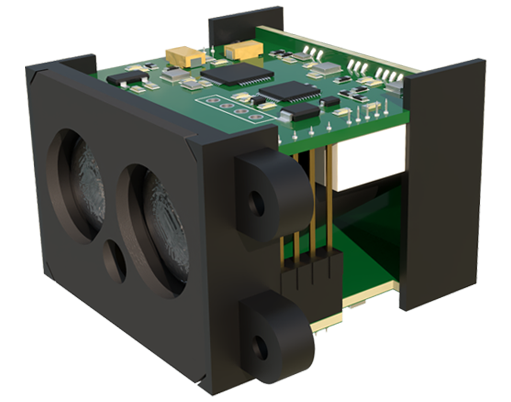
Laser distance sensors, also known as laser rangefinders or LiDAR (Light Detection and Ranging) sensors in some contexts, are pivotal instruments in modern industrial automation, robotics, and quality control. Their operation is grounded in the precise principles of optics and photonics, offering non-contact, high-accuracy measurement solutions. At their core, these sensors function by emitting a focused laser beam toward a target object and analyzing the reflected light to determine distance.
The fundamental working principle can be categorized primarily into two methods: time-of-flight (ToF) and triangulation. The time-of-flight method is conceptually straightforward. The sensor emits a short pulse of laser light. A high-speed photodetector within the sensor then captures the light reflected back from the target. An internal electronic timer measures the exact time interval between the emission and the reception of the pulse. Since the speed of light (c) is a known constant (approximately 3×10^8 m/s), the distance (d) to the target can be calculated using the formula: d = (c × t) / 2, where t is the measured time of flight. The division by two accounts for the round-trip journey of the light. This method is highly effective for long-range measurements, from several meters to kilometers, and is commonly used in surveying, automotive safety systems, and airborne terrain mapping.

The second major principle, triangulation, is preferred for shorter ranges requiring extremely high precision, often in the sub-millimeter range. In a triangulation sensor, the laser emitter, the receiving lens, and a position-sensitive detector (PSD) or a CMOS/CCD array are arranged in a fixed geometric triangle. The laser projects a visible spot onto the target surface. The reflected light from this spot is focused through the receiving lens onto the PSD. The position where this light spot falls on the detector is not fixed; it shifts linearly depending on the distance to the target. By precisely measuring this displacement on the detector, the sensor's internal processor calculates the exact distance using trigonometric relationships. This method provides exceptional accuracy and resolution for applications like assembly line inspection, wafer alignment in semiconductor manufacturing, and thickness measurement of materials.
Beyond these core principles, advanced modulation techniques like phase-shift measurement are employed in continuous-wave ToF sensors for enhanced resolution at medium ranges. Here, the intensity of the emitted laser beam is modulated at a known frequency. The sensor measures the phase shift between the emitted and reflected modulated wave. The distance is derived from this phase difference, allowing for very precise measurements without needing to time ultra-short pulses.
The choice of laser wavelength is critical and depends on the application. Common industrial sensors use visible red lasers (around 650 nm) for easy alignment, or infrared lasers (e.g., 850 nm, 905 nm) which are less affected by ambient light and safer for the human eye. For demanding environments with high ambient light or specific material properties, specialized wavelengths may be selected.

The advantages of laser distance sensors are numerous. They enable non-contact measurement, eliminating mechanical wear and allowing measurement of delicate, hot, or moving objects. They offer high speed, taking thousands of measurements per second, which is essential for dynamic processes. Their accuracy and repeatability are superior to many contact-based methods. However, challenges exist. The characteristics of the target surface, such as color, reflectivity, texture, and angle, can significantly influence the signal strength and measurement reliability. A highly reflective or specular surface may cause saturation or erroneous reflections, while a dark, absorbent, or transparent surface may return too weak a signal. Modern sensors incorporate sophisticated algorithms, automatic exposure control, and filters to compensate for these factors.
In industrial practice, these sensors are ubiquitous. They are integral to robotic guidance systems, ensuring precise pick-and-place operations and path planning. In logistics, they measure parcel dimensions for automated sorting and storage. In metal processing, they monitor roll gaps and sheet thickness. In the automotive industry, they are used for vehicle assembly gap control and as part of advanced driver-assistance systems (ADAS) for collision avoidance. Their role in facilitating Industry 4.0, with its emphasis on data-driven process optimization and cyber-physical systems, is indispensable.
In conclusion, the operation of laser distance sensors is a sophisticated interplay of laser physics, precision optics, and high-speed electronics. Understanding the principles of time-of-flight and triangulation allows engineers to select the appropriate sensor technology for a given application, balancing range, accuracy, speed, and environmental robustness. As laser and detector technologies continue to advance, these sensors will become even more accurate, compact, and intelligent, further solidifying their critical role in industrial automation and measurement science.