Laser rangefinder sensors, often metaphorically called the "eyes" of automated systems, are pivotal components in modern industrial and technological applications. These devices operate on the principle of Time-of-Flight (ToF), phase-shift, or triangulation to measure distances with exceptional accuracy and speed. By emitting a focused laser beam toward a target and analyzing the reflected light, they calculate the distance based on the time delay or phase difference. This non-contact measurement capability makes them indispensable in environments where precision, reliability, and safety are paramount.
In industrial automation, laser rangefinders are integral to robotics, enabling precise object detection, positioning, and navigation. For instance, in automated guided vehicles (AGVs), they help map surroundings and avoid obstacles, ensuring smooth and efficient material handling. Similarly, in manufacturing assembly lines, these sensors verify component placement, measure dimensions, and inspect quality without physical contact, reducing wear and tear and minimizing production errors. Their high resolution and rapid response time allow for real-time adjustments, enhancing overall system throughput.
Beyond manufacturing, laser rangefinders play a crucial role in construction and surveying. They facilitate accurate distance measurements for land mapping, building layout, and volume calculations, significantly improving project efficiency and reducing manual labor. In the automotive industry, they are key to advanced driver-assistance systems (ADAS), such as adaptive cruise control and collision avoidance, by continuously monitoring the distance to nearby vehicles or obstacles. This technology contributes to safer driving experiences and paves the way for autonomous vehicles.
The advantages of laser rangefinder sensors include their long-range capability, often extending to hundreds of meters, and their immunity to ambient light interference, thanks to coherent laser light. However, challenges such as sensitivity to reflective surfaces, atmospheric conditions like fog or dust, and higher costs compared to ultrasonic or infrared sensors must be considered. Innovations in solid-state designs and integration with artificial intelligence are addressing these limitations, enabling smarter, more adaptive sensors.
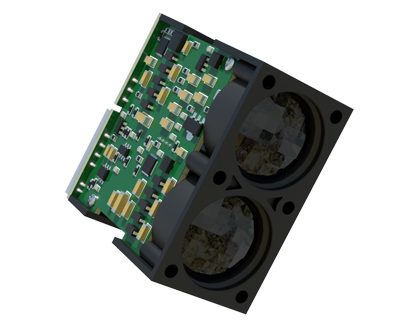
Looking ahead, the evolution of laser rangefinder technology is driven by trends like miniaturization, increased affordability, and enhanced connectivity through the Internet of Things (IoT). As industries embrace Industry 4.0, these sensors will become even more critical for data-driven decision-making and automation. By providing precise spatial awareness, they empower systems to "see" and interact with their environment intelligently, solidifying their status as the essential eyes of modern automation. For engineers and technicians, understanding their operation, selection criteria, and maintenance is vital for optimizing performance in diverse applications, from smart factories to autonomous systems.