In the realm of industrial automation and control systems, selecting the appropriate sensor for object detection is a critical decision that impacts efficiency, reliability, and cost. Among the plethora of options, diffuse reflective sensors and proximity sensors are two fundamental technologies often considered for similar applications, yet they operate on distinct principles and are suited to different environments. Understanding their core differences is essential for engineers and system integrators to make informed design choices.
Fundamental Operating Principles
The primary distinction lies in their method of detection. A diffuse reflective sensor, often called a diffuse sensor or photoelectric proximity sensor, is an active optoelectronic device. It contains both a light emitter (typically an LED) and a receiver within a single housing. The emitter projects a beam of light, usually visible red, infrared, or laser light, towards a target. When the target enters the sensing range, it reflects a portion of this light diffusely back towards the sensor's receiver. The sensor detects this reflected light, triggering an output signal. The sensing distance is highly dependent on the target's color, surface texture, and material. Light-colored, matte surfaces reflect more light and can be detected at greater distances than dark, shiny, or absorbent surfaces.
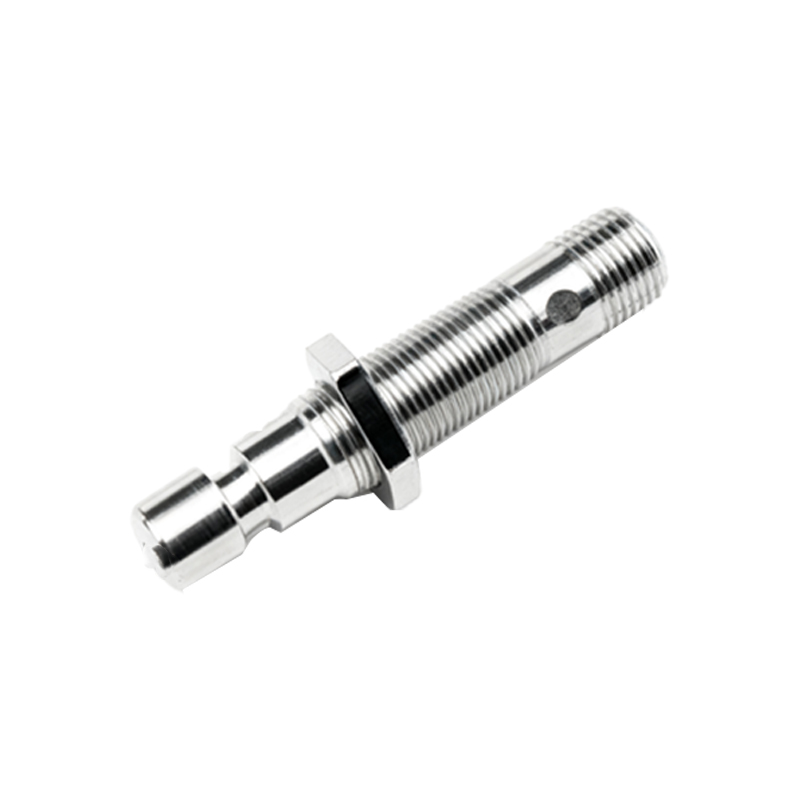
In contrast, a proximity sensor, specifically an inductive or capacitive proximity sensor, operates without emitting visible light. An inductive proximity sensor generates an electromagnetic field from its sensing face. When a metallic object (the target) enters this field, it induces eddy currents within the metal, causing a change in the oscillation amplitude of the sensor's internal circuit. This change is detected and converted into an output switch signal. A capacitive proximity sensor works similarly but generates an electrostatic field. It can detect both metallic and non-metallic materials (like plastics, wood, liquids, or granules) by sensing changes in capacitance caused by the target's dielectric constant.
Key Comparative Parameters
1. Target Material: This is the most decisive factor. Diffuse sensors can detect virtually any solid object, regardless of its material composition—plastic, metal, cardboard, wood, etc. Proximity sensors are material-specific: inductive for metals only, capacitive for a wider range including non-metals and liquids.
2. Sensing Range: Diffuse sensors generally offer longer sensing ranges, from a few centimeters up to several meters for laser-based models. Proximity sensors have much shorter ranges, typically from a few millimeters to about 60 millimeters for inductive types, and slightly more for capacitive types. The range of a diffuse sensor is variable and target-dependent.
3. Environmental Sensitivity: Diffuse sensors can be susceptible to ambient light interference, dust, fog, or steam that may scatter or block the light beam. They may require careful mounting to avoid background reflections. Proximity sensors, being non-optical, are largely immune to ambient light, dust (unless conductive), and opaque contaminants. However, inductive sensors can be affected by other metal objects in close proximity, and capacitive sensors by changes in humidity or the presence of non-target materials.
4. Response Time and Switching Frequency: Proximity sensors, especially inductive ones, typically have extremely fast response times and high switching frequencies, making them ideal for high-speed counting or positioning of metal parts. Diffuse sensors have good response times but may be slightly slower due to the light propagation and processing time.
5. Color and Surface Dependence: As noted, the performance of a diffuse sensor is directly tied to the target's reflectivity. A black rubber belt and a white paper box require completely different sensitivity settings. Proximity sensors are unaffected by color or surface finish (for inductive, it's the metal type and size; for capacitive, it's the material's dielectric property).
Typical Application Scenarios
Choosing between them often comes down to the application:
Use a Diffuse Reflective Sensor when: Detecting non-metallic objects (boxes, bottles, plastic components), needing a longer detection range, detecting transparent objects (with special models), or when the sensor must be mounted on one side of the object's path. Common uses include packaging lines, material handling, and assembly verification.
Use an Inductive Proximity Sensor when: Detecting the presence, absence, or position of metal objects with high precision and speed, in dirty or wet environments where optical sensors would fail. Common uses include machine tooling, robotic end-effectors, and metal part counting.
Use a Capacitive Proximity Sensor when: Detecting non-metallic materials, liquid levels, granular materials, or through a non-metallic container wall. Common uses include fill level control, wood processing, and detection of plastics or glass.
In summary, while both sensor types provide "presence detection," a diffuse reflective sensor is an optical device measuring reflected light, and