Magnetic proximity switches and inductive sensors represent foundational components within modern industrial automation systems. These devices provide non-contact detection of metallic objects, enabling precise control, positioning, and safety functions across countless applications. Their reliability, durability, and versatility make them indispensable in environments ranging from automotive assembly lines and packaging machinery to material handling systems and robotic cells.
A magnetic proximity switch, often termed a reed switch or magnetically actuated sensor, operates on a relatively simple principle. It consists of a sealed glass tube containing two ferromagnetic reeds. When an external magnetic field from a permanent magnet or an electromagnet approaches, the reeds magnetize, attract each other, and make contact, closing the electrical circuit. Upon removal of the magnetic field, the reeds' spring force separates them, opening the circuit. This binary on/off signal is used to indicate the presence or absence of a target, typically the magnet itself. Common applications include door and lid position sensing, cylinder piston detection, and level control in tanks using float magnets. Their key advantages are low power consumption, simplicity, and the ability to operate in dirty or wet environments as the sensing element is hermetically sealed. However, they generally require a specific magnetic field strength and orientation for reliable operation and are primarily used to detect magnets rather than generic ferrous metals.
In contrast, inductive proximity sensors detect all metals—ferrous (like iron and steel) and non-ferrous (like aluminum, copper, and brass)—without requiring a dedicated magnet. The core of an inductive sensor is a coil wound around a ferrite core, forming part of an oscillator circuit. When a metallic object enters the sensor's electromagnetic field, eddy currents are induced in the target. This causes a change in the oscillation amplitude or frequency. The sensor's internal circuitry detects this change and triggers a solid-state output switch (typically PNP or NPN). The sensing range is relatively short, usually a few millimeters to tens of millimeters, and is influenced by the target's material, size, and shape, with standardized correction factors for different metals.
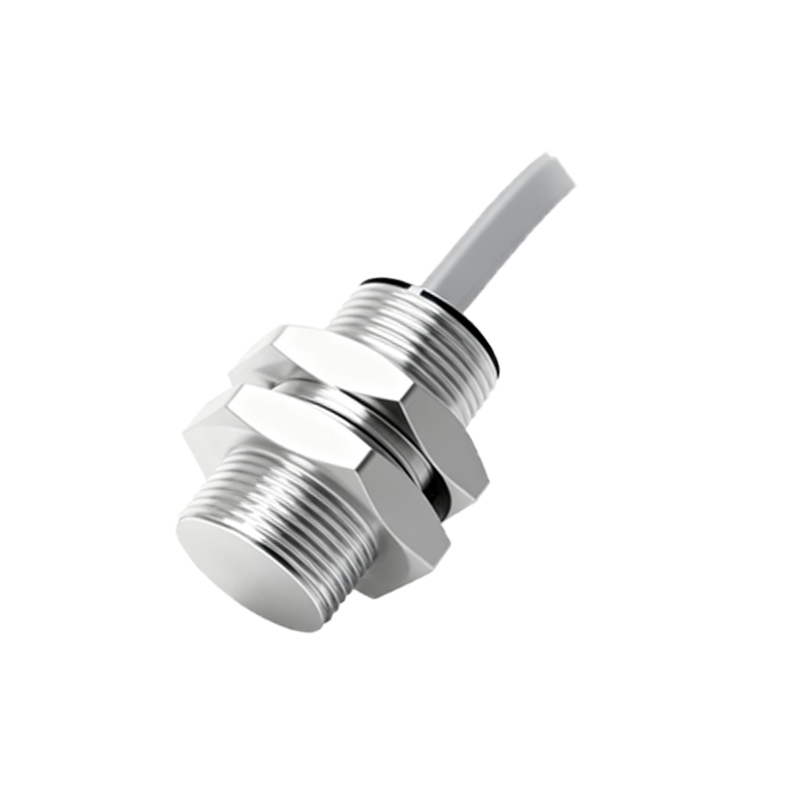
Modern inductive sensors offer significant advancements. They feature robust housings in materials like nickel-plated brass, stainless steel, or PBT plastic, providing high resistance to shock, vibration, and harsh industrial fluids. Many models incorporate LED status indicators for easy diagnostics. Key performance specifications include switching frequency (how fast they can detect objects), repeat accuracy, and temperature range. Specialized variants include factor-1 sensors (equal sensing distance for all metals), analog output sensors providing distance-proportional signals, and weld-field immune models designed to function reliably near strong magnetic fields from resistance welding equipment.
The choice between a magnetic switch and an inductive sensor depends on the application's specific demands. Magnetic switches are ideal for detecting the position of a moving component that has an attached magnet, especially where physical contact is impossible or undesirable, and where environmental contaminants are a major concern. Their passive nature makes them highly reliable for safety interlocks. Inductive sensors, being active electronic devices, are the go-to solution for detecting the presence of any metal part—a gear tooth, a machine tool, a can on a conveyor, or a metal flag on a rotating shaft. They offer faster response times, higher switching frequencies for high-speed counting, and more precise positioning capabilities.
Installation and integration are critical for optimal performance. Proper mounting, ensuring the correct sensing distance and avoiding flank (side) detection, is essential. Electrical considerations include selecting the correct voltage supply (10-30V DC being most common for 3-wire DC sensors), wiring the output to the PLC or controller correctly (sourcing vs. sinking), and ensuring protection against overcurrent, short-circuits, and reverse polarity. For inductive sensors in particular, maintaining adequate clearance from other metal objects and other sensors prevents mutual interference.
In summary, magnetic proximity switches and inductive sensors are complementary technologies that form the sensory backbone of automated systems. Understanding their operating principles, strengths, and limitations allows engineers and technicians to select, apply, and maintain the right sensor for the task, thereby enhancing system reliability, efficiency, and safety. As Industry 4.0 and the Industrial Internet of Things (IIoT) evolve, these sensors continue to adapt, with increasing integration of diagnostic data and IO-Link communication for smarter, more connected factories.