In the rapidly evolving landscape of industrial automation and precision measurement, Single-Line Laser Time-of-Flight (ToF) sensors have emerged as a pivotal technology. These sensors operate on a fundamental principle: they emit a modulated laser beam in a single line, measure the time it takes for the light to reflect off a target and return to the sensor, and then calculate the distance based on the known speed of light. This direct time-of-flight method provides high-accuracy, real-time distance data, making it indispensable for a wide array of applications from robotics and logistics to automotive and safety systems.
The core advantage of a single-line configuration lies in its balance of simplicity, speed, and resolution. Unlike area-scanning ToF cameras that capture entire 3D point clouds, a single-line laser ToF sensor scans a precise line across a scene. This focused approach allows for extremely fast data acquisition rates, often in the kilohertz range, which is critical for high-speed production lines or dynamic robotic guidance. The sensor generates a continuous profile of distances along that line, creating a 2.5D "slice" of the environment. This profile is perfect for tasks like contour profiling, object height verification, edge detection, and precise positioning.
Key technical specifications define the performance of these sensors. The working range, which can vary from a few centimeters to several meters, must be selected based on the application's needs. Accuracy and repeatability are paramount; high-quality industrial sensors can achieve sub-millimeter precision. The laser's wavelength, typically in the near-infrared spectrum (e.g., 850nm or 905nm), affects its visibility and performance under different lighting conditions. Furthermore, the modulation frequency of the laser pulse is crucial, as higher frequencies can improve resolution but may reduce the maximum unambiguous range. Environmental robustness is another critical factor. Industrial-grade single-line ToF sensors are designed with high Ingress Protection (IP) ratings to withstand dust, moisture, and mechanical vibrations. They must also maintain performance under varying ambient light conditions, utilizing optical filters and advanced signal processing algorithms to distinguish the weak return signal from background noise.
In practical applications, these sensors are transformative. In automated warehouses, they are mounted on Autonomous Mobile Robots (AMRs) or gantry systems for pallet detection, load profiling, and navigation, ensuring efficient and collision-free material handling. On assembly lines, they perform precise height and width checks of components, detect missing parts, or guide robotic arms for pick-and-place operations with micron-level precision. In the automotive sector, they are used for vehicle contour scanning, brake disc thickness measurement, and as a component in advanced driver-assistance systems (ADAS) for close-range obstacle detection.
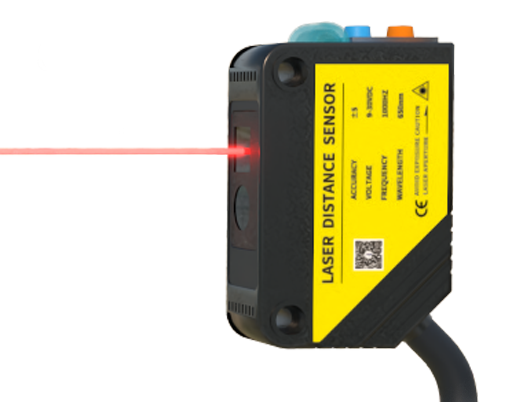
When integrating a single-line laser ToF sensor, engineers must consider several factors. The mounting angle and distance must be calibrated to ensure the laser line optimally intersects the target area. The reflectivity of target surfaces—from highly reflective metals to dark, absorbent materials—can significantly impact the signal strength and may require sensor adjustment or the use of external targets. Data interpretation is also key; the raw distance profile often requires filtering, averaging, and analysis through programmable logic controllers (PLCs) or industrial PCs to extract actionable insights, such as triggering an actuator or flagging a defect.
Looking ahead, the future of single-line laser ToF sensors is geared towards even greater miniaturization, higher speeds, and enhanced intelligence. Integration with artificial intelligence for direct on-sensor data processing (edge AI) is a growing trend, allowing for immediate decision-making without central processor latency. Furthermore, advancements in laser diode and SPAD (Single-Photon Avalanche Diode) receiver technology promise improvements in power efficiency, range, and performance in challenging environments.
In conclusion, the single-line laser Time-of-Flight sensor is a robust, versatile, and highly effective tool for non-contact measurement and profiling. Its ability to deliver fast, accurate, and reliable distance data in a compact form factor makes it a cornerstone of modern industrial automation, driving efficiency, quality, and safety across countless sectors. As technology progresses, its role is set to become even more central in the smart factories and intelligent systems of tomorrow.