In the realm of industrial automation and machine control, proximity sensors are indispensable components. They detect the presence or absence of an object without physical contact, enabling precise, reliable, and wear-free operation. While much attention is given to their sensing principles, output types, and mounting considerations, the role of the power supply is a fundamental yet sometimes overlooked aspect that directly dictates sensor performance, stability, and longevity. This article delves into the critical functions and considerations of the power supply for proximity sensors.
At its core, the power supply provides the electrical energy necessary for the sensor to function. For inductive or capacitive proximity sensors, this energy powers an internal oscillator circuit. In an inductive sensor, this generates a high-frequency electromagnetic field at the sensing face. When a metallic target enters this field, eddy currents are induced, causing a change in the oscillation amplitude. The sensor's evaluation circuit detects this change and triggers a solid-state output switch. Without a stable and clean power source, this oscillator cannot generate a consistent field, leading to unreliable detection, reduced sensing range, or false triggering. Similarly, for capacitive sensors detecting non-metallic materials, a stable power supply ensures consistent sensitivity to changes in capacitance.
The specifications of the power supply are paramount. Most industrial proximity sensors operate on Direct Current (DC) voltages, with common ranges being 10-30V DC or 10-65V DC for wider operating models. Ensuring the supply voltage remains within the sensor's specified range is crucial. Undervoltage can prevent the sensor from turning on or cause it to reset intermittently, while overvoltage can instantly damage internal electronic components, leading to catastrophic failure. Furthermore, the power supply must be capable of delivering sufficient current. While individual sensors typically draw low current (often below 200mA), the cumulative load of multiple sensors on a single supply must be calculated to avoid overloading.
Beyond providing basic energy, a high-quality power supply acts as a guardian against electrical noise and transients. Industrial environments are electrically hostile, filled with noise from motor drives, solenoids, welding equipment, and radio frequency interference. This electrical noise, if coupled into the sensor's power lines, can be misinterpreted by the sensitive detection circuitry as a valid target signal, causing erratic behavior. A well-designed power supply with proper filtering and regulation smooths out these ripples and variations, providing a "clean" DC voltage. Additionally, proximity sensors, especially two-wire AC/DC types, are susceptible to voltage spikes or surges. Incorporating surge protection devices or using power supplies with built-in transient voltage suppression is a best practice to enhance system robustness.
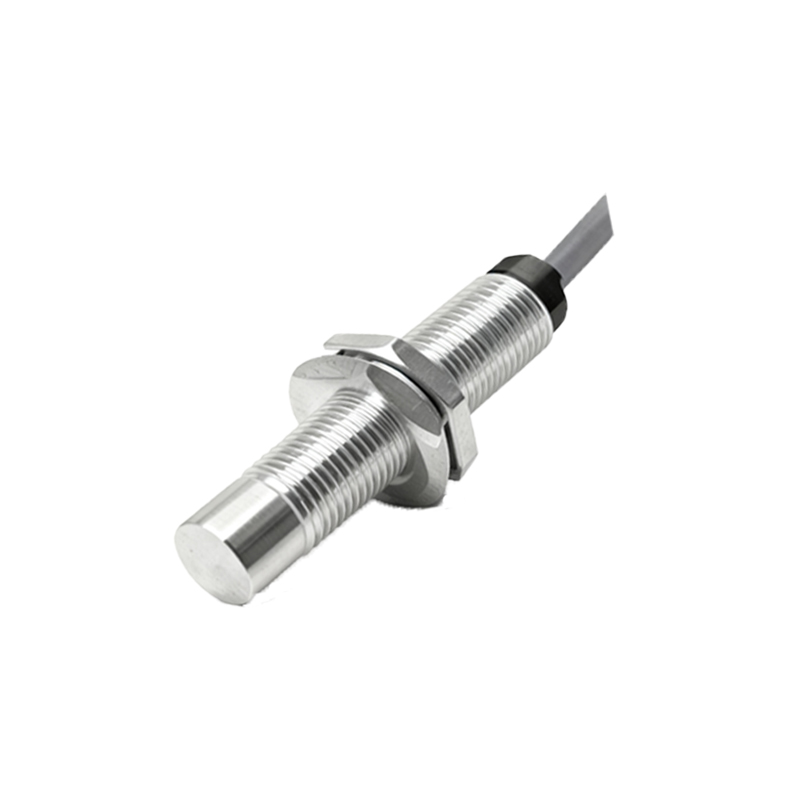
The choice of power supply also interacts with the sensor's output configuration. Three-wire DC sensors have separate wires for power supply positive, power supply negative (common), and the output signal. Their power supply needs are straightforward. Two-wire sensors, however, are connected in series with the load. The power supply must account for the voltage drop across the sensor itself (often called the residual voltage or saturation voltage) to ensure sufficient voltage remains for the load (e.g., a PLC input) to activate correctly. An under-sized power supply in a two-wire circuit may power the sensor but fail to switch the load reliably.
Finally, considerations for wiring and grounding directly impact power quality. Using shielded cables for power and signal lines, especially over long distances or in high-noise areas, and grounding the shield properly at one end can prevent noise ingress. Ensuring tight connections and correct polarity prevents voltage drops and potential damage. In essence, the power supply is not merely a source of electricity; it is the foundation upon which the sensor's accuracy and reliability are built. A robust, regulated, and appropriately sized power supply, installed with good electrical practices, transforms a proximity sensor from a simple component into a dependable and precise element of a control system, ensuring seamless automation and minimizing costly downtime.