In the demanding world of industrial material handling, overhead cranes are indispensable workhorses. Their efficiency and safety are paramount, directly impacting operational throughput and workplace security. A critical, yet often overlooked, component in modernizing crane systems is the integration of advanced sensing technology. Among these, laser displacement sensors have emerged as a transformative tool, providing non-contact, high-precision measurement capabilities that redefine positioning, control, and monitoring. This guide delves into the operational principles, key applications, and crucial selection criteria for laser displacement sensors in overhead crane environments.
At its core, a laser displacement sensor operates on the principle of optical triangulation or time-of-flight measurement. In the more common triangulation method, the sensor projects a focused laser beam onto the target surface—be it a hook block, a lifted load, or a runway rail. The diffusely reflected light is then captured by a receiving lens at a known angle and focused onto a position-sensitive detector, typically a CMOS or CCD array. Any change in the target's distance causes a proportional shift in the position of the light spot on the detector. This shift is processed by the sensor's internal electronics to calculate the exact displacement with remarkable accuracy, often in the micron or sub-millimeter range. This non-contact method is ideal for crane applications as it eliminates mechanical wear and can measure objects that are hot, fragile, or in motion.
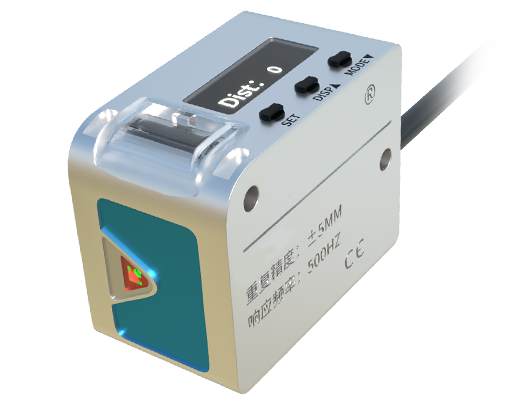
The applications for laser displacement sensors on overhead cranes are diverse and impactful. One primary use is hook height and load positioning. By continuously measuring the distance to the hook or the load itself, the sensor provides real-time feedback to the crane's control system. This enables automated hoisting to predefined heights with exceptional repeatability, eliminating manual guesswork and enhancing cycle times. Furthermore, it serves as a critical input for anti-sway systems. By monitoring the load's position relative to a reference point, the control system can actively dampen pendulum motions, allowing for faster and safer load placement, especially in confined spaces or with delicate cargo.
Another vital application is runway alignment and wheel flange gap monitoring. Misaligned crane bridges or gantties can cause accelerated wear on rails and wheels, leading to increased maintenance costs and potential safety hazards. A laser sensor mounted on the crane's end truck can precisely measure the gap between the wheel flange and the rail or monitor the lateral alignment. This data facilitates predictive maintenance, alerting operators to misalignment before it causes catastrophic failure. Similarly, sensors can be used for crane skew detection in systems with multiple driven wheels, ensuring synchronized travel and preventing structural stress.
Load profiling and collision avoidance represent advanced applications. An array of sensors can profile the dimensions of an irregular load, aiding in automated storage or ensuring it fits within a designated envelope. For collision avoidance, sensors create an invisible "safety curtain" around the crane or its hook, detecting intrusions into predefined zones and triggering immediate slowdowns or stops to prevent accidents with obstacles, other cranes, or personnel.
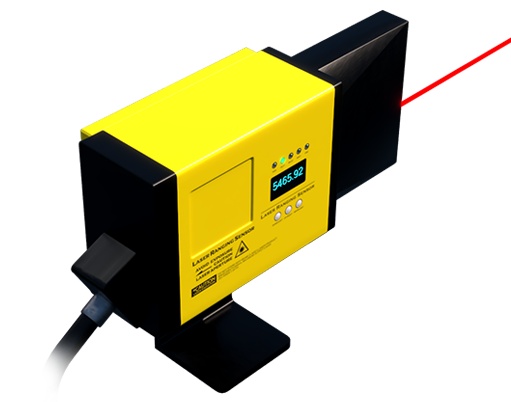
Selecting the right laser displacement sensor for an overhead crane requires careful consideration of several environmental and technical factors. Measurement Range and Standoff Distance are fundamental. The sensor must have a sufficient range to cover the entire required displacement, from the closest to the farthest measurement point, with an appropriate standoff (the distance from the sensor head to the middle of its range). Accuracy and Resolution must match the application's needs; hook positioning may require millimeter accuracy, while alignment checks might need micron-level resolution.
The Environmental Rating is non-negotiable. Crane environments are harsh, featuring dust, moisture, oil mist, and significant vibration. Sensors must be housed in robust enclosures with ingress protection ratings of at least IP67 to withstand washdowns and dust. Resistance to Optical Interference is critical. The sensor must be immune to ambient light from factory skylights or welding arcs. Models with modulated laser light or specialized filters are essential. Output and Connectivity should integrate seamlessly with existing crane PLCs or control networks. Common outputs include analog (4-20mA, 0-10V), digital (RS-485, Ethernet/IP, PROFINET), and discrete switching signals.
Finally, mechanical mounting and thermal stability are key. The sensor and its bracket must withstand constant vibration and potential impacts. Thermal drift specifications ensure measurements remain stable despite temperature fluctuations in a factory setting. Consulting with sensor specialists who understand industrial crane dynamics is highly recommended to navigate these selection parameters and ensure a successful, reliable installation.

In conclusion, laser displacement sensors are no longer just auxiliary devices but are becoming integral to intelligent, safe, and efficient overhead crane operation. By providing precise, real-time spatial data, they enable automation, enhance safety protocols, and facilitate condition-based maintenance. As Industry 4.0 and smart factory initiatives advance, the role of these sophisticated sensors in bridging the gap between physical crane operations and digital control systems will only grow more pronounced, driving productivity and safety to new heights.