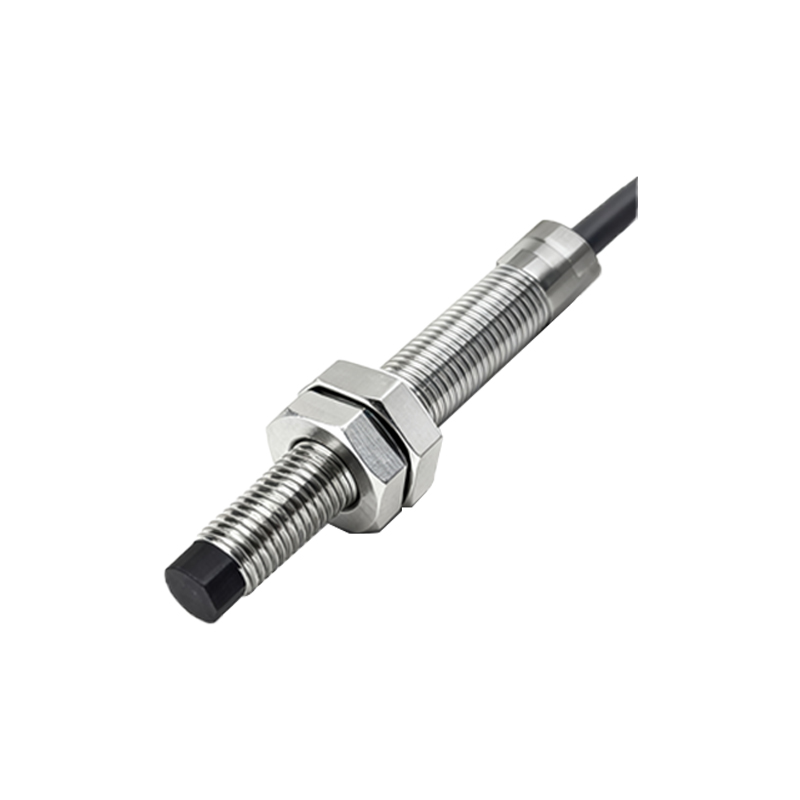
Proximity switch sensor FC, a critical component in modern industrial automation, represents a sophisticated class of non-contact sensing devices designed for reliable object detection in demanding environments. As an electrical engineer, understanding the operational principles, technical specifications, and application nuances of these sensors is paramount for designing robust control systems. Fundamentally, the FC series utilizes electromagnetic or capacitive sensing fields to detect the presence or absence of metallic or non-metallic targets without physical contact, thereby eliminating mechanical wear and ensuring long-term operational integrity.
The core technology behind proximity switch sensor FC often involves an oscillator circuit that generates a high-frequency electromagnetic field at the active face of the sensor. When a target object enters this field, it induces eddy currents (in the case of inductive sensors for metals) or alters the capacitance (in capacitive models for various materials), leading to a change in the oscillation amplitude. This change is detected by a threshold circuit, which subsequently triggers a solid-state output switch. The output, typically in PNP or NPN configuration, provides a clean signal to programmable logic controllers (PLCs) or other control units. Key performance parameters include sensing distance, which is rated nominally and can be influenced by target material, size, and environmental factors; repeat accuracy, ensuring consistent detection at the same point; and switching frequency, defining how rapidly the sensor can respond to targets passing by.
Electrical installation and wiring are straightforward yet require attention to detail. Most FC sensors operate on a wide range of DC voltages, commonly 10-30V DC, and feature protection against reverse polarity, short-circuit, and overload. The standard three-wire configuration includes power (brown), ground (blue), and output (black) leads. Shielding and proper grounding are essential in electrically noisy industrial settings to prevent false triggering. Furthermore, many models come with built-in LED indicators for operational status and alignment assistance, significantly simplifying commissioning and troubleshooting processes.
The application spectrum for proximity switch sensor FC is vast. In automotive manufacturing, they are indispensable for part presence verification on assembly lines, robotic arm end-effector positioning, and conveyor belt control. In packaging machinery, they detect fill levels, count products, and monitor cap placement. Their robust housing, often made of nickel-plated brass or stainless steel with IP67 or higher ingress protection ratings, makes them suitable for harsh conditions involving coolants, oils, and dust. A critical advantage is their immunity to surface conditions like dirt, moisture, or color, unlike optical sensors, ensuring stable performance where cleanliness cannot be guaranteed.

When selecting an FC series sensor, engineers must consider several factors beyond the basic sensing type. The choice between shielded (flush-mountable) and unshielded versions affects the installation and sensing field geometry. Temperature tolerance is vital for applications near ovens or in cold storage. Additionally, some advanced models offer analog outputs or IO-Link communication, enabling not just binary detection but also distance measurement and parameter configuration via the control network, aligning with Industry 4.0 trends for smart sensor data integration.
Maintenance is minimal but proactive checks are recommended. Periodically verifying the sensing distance and cleaning the sensor face from accumulated metallic swarf or debris prevents performance degradation. It is also crucial to ensure that the sensor is not mechanically stressed or misaligned due to vibration. In summary, the proximity switch sensor FC is a versatile, reliable workhorse in industrial electrical design. Its correct selection, installation, and integration form the backbone of efficient, fail-safe automated systems, directly impacting productivity, safety, and operational cost. A deep technical grasp of its characteristics allows engineers to leverage its full potential across countless automation challenges.