In the realm of industrial automation, proximity sensors stand as silent sentinels, enabling precise, non-contact detection of objects. Among the diverse range of form factors, the M5 threaded cylindrical sensor has emerged as a workhorse, prized for its compact size, robust construction, and reliable performance. This article delves into the technical specifications, operational principles, selection criteria, and typical applications of the M5 proximity sensor, providing a detailed guide for engineers and technicians.
The "M5" designation refers specifically to the sensor's housing thread size, which is metric 5mm in diameter. This compact form factor allows for installation in space-constrained environments where larger sensors would be impractical. Despite their small size, M5 sensors are engineered to withstand the harsh conditions typical of industrial settings. They are commonly housed in stainless steel or nickel-plated brass bodies, offering excellent resistance to corrosion, impacts, and vibration. Many models are also available with IP67 or IP68 ingress protection ratings, making them suitable for washdown areas or outdoor use.
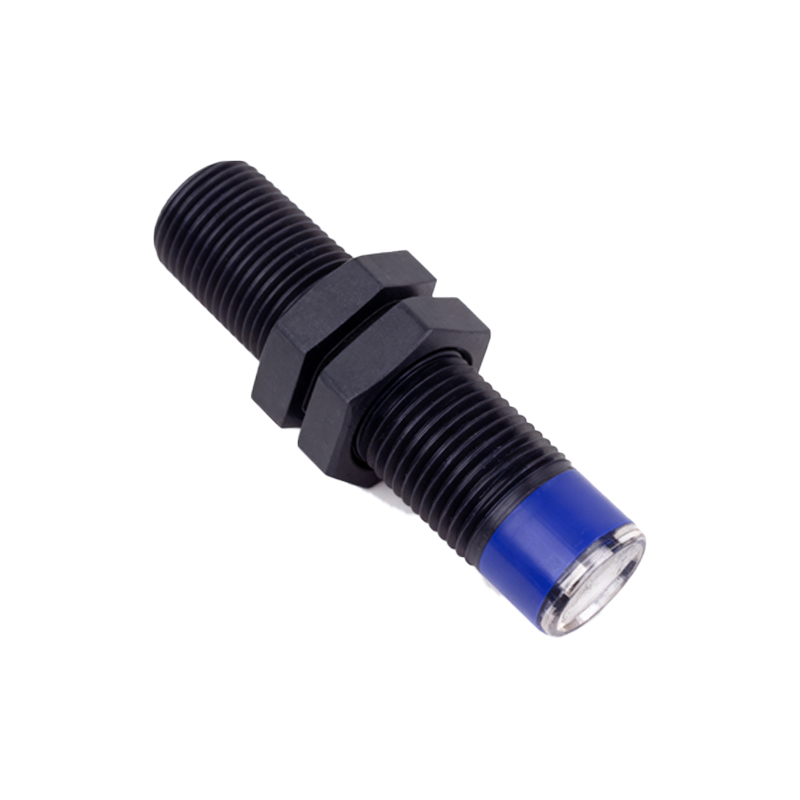
Proximity sensors operate on several fundamental principles, with inductive and capacitive types being the most prevalent for M5 sizes. Inductive M5 proximity sensors are the standard choice for detecting metallic objects. They generate an electromagnetic field from a coil and oscillator circuit. When a ferrous or non-ferrous metal target enters this field, it induces eddy currents, causing a change in the oscillation amplitude. This change is detected by the sensor's circuitry, which then switches the output state. The sensing range for an inductive M5 sensor is typically short, often between 0.5mm to 2mm, depending on the target material and specific model. This short range is a design feature that enhances noise immunity and prevents unintended triggering.
For non-metallic targets—such as glass, plastic, wood, or liquids—capacitive M5 proximity sensors are employed. These sensors function by generating an electrostatic field. The presence of any material with a dielectric constant different from air alters the capacitance of the sensor's circuit, triggering an output switch. Capacitive M5 sensors generally have slightly longer sensing distances than their inductive counterparts and can be adjusted via a potentiometer to sense different materials and ignore background objects.
The electrical output of M5 sensors is another critical specification. Two-wire DC, three-wire DC (PNP or NPN), and AC variants are available. Three-wire DC sensors are most common in modern control systems due to their simple wiring and compatibility with programmable logic controllers (PLCs). The output can be normally open (NO) or normally closed (NC), and switching current ratings are typically in the range of 100-200mA, sufficient to drive small relays, PLC inputs, or indicator lamps directly.
Selecting the right M5 sensor requires careful consideration of several parameters beyond just thread size. The first is the sensing principle: inductive for metals, capacitive for other materials. Next, the required sensing distance (Sn) must be determined, always considering the reduction factor for non-ferrous metals when using inductive sensors. The operating voltage (e.g., 10-30V DC, 20-250V AC) must match the control system's power supply. Environmental factors like temperature extremes, exposure to chemicals, or continuous submersion dictate the required housing material and IP rating. Finally, the output configuration (2-wire/3-wire, PNP/NPN, NO/NC) must be compatible with the downstream control circuitry.
The applications for M5 proximity sensors are vast and varied across industries. In automated assembly lines, they are used for precise part presence verification, counting, and end-of-stroke detection on miniature pneumatic cylinders. Within the packaging machinery sector, they detect labels, monitor film breaks, or confirm the position of small components. Robotics extensively utilizes M5 sensors for end-effector tooling confirmation and delicate object detection. In semiconductor and electronics manufacturing, their small size is indispensable for detecting micro-components on circuit boards or inside precision equipment.
Installation and maintenance are straightforward but crucial for optimal performance. Proper mounting in a correctly tapped hole is essential to avoid damaging the threads. Engineers must ensure an adequate lateral and axial clearance zone around the sensor's active face, as specified in the datasheet, to prevent false triggers from the mounting nut or surrounding metal. Regular cleaning of the sensing face to remove oil, dust, or metal chips is a simple yet effective maintenance task that ensures long-term reliability.
In conclusion, the M5 proximity sensor is a quintessential component in the toolkit of industrial automation. Its miniature footprint belies its significant capability to provide reliable, solid-state switching in demanding environments. By understanding its operating principles, key specifications, and application nuances, engineers can effectively leverage this versatile sensor to enhance machine efficiency, ensure product quality, and bolster system reliability. As automation trends continue toward miniaturization and higher precision, the