Laser precision sensors represent a critical advancement in industrial measurement and automation, offering unparalleled accuracy, speed, and reliability. These devices operate on fundamental principles of optics and photonics, enabling non-contact measurement of distance, displacement, thickness, and profile with micron-level resolution. The core working principle involves the emission of a focused, coherent laser beam toward a target object. The sensor then detects the interaction of this beam with the target, typically by analyzing the reflected light.
Two primary methodologies dominate: triangulation and time-of-flight (ToF). Triangulation-based laser sensors are ideal for short to medium-range measurements with extreme precision. A laser diode projects a visible or infrared spot onto the target surface. The reflected light is focused onto a position-sensitive detector (PSD) or a CMOS/CCD array at a specific angle. As the target's distance changes, the position of the light spot on the detector shifts linearly. This displacement is calculated using trigonometric principles, converting the optical signal into a precise distance value. This method excels in applications like wafer thickness measurement, component profiling, and vibration analysis, where sub-micron repeatability is required.
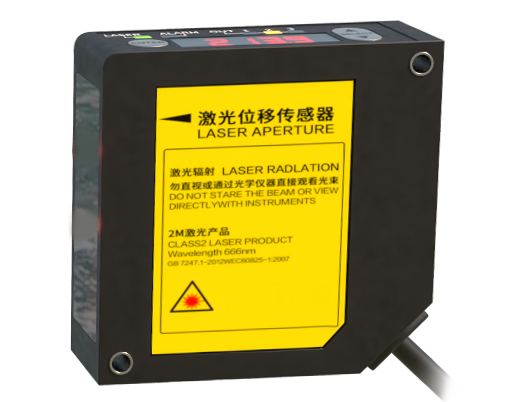
Time-of-flight sensors, conversely, measure the round-trip time for a laser pulse to travel to the target and back. The distance is calculated using the constant speed of light. While traditionally used for longer ranges with slightly lower resolution, modern phase-shift ToF and pulsed-light ToF technologies have significantly improved their precision, making them suitable for level sensing, bulk material monitoring, and large-volume 3D scanning. The key advantage is their insensitivity to surface color, texture, or reflectivity variations, which can challenge triangulation sensors.
A critical component is the laser source itself. Semiconductor laser diodes, often with wavelengths in the visible red (650 nm) or near-infrared (850 nm, 905 nm) spectrum, are commonly used for their compact size and efficiency. The coherence and collimation of the laser beam allow for a small, intense spot size, enabling measurements on tiny features. Advanced sensors incorporate blue laser technology (e.g., 405 nm) for enhanced resolution on organic or shiny surfaces, as the shorter wavelength reduces speckle noise and improves focus.
Signal processing is the intelligence behind the raw optical data. The detected analog signal undergoes amplification, filtering, and digitization. Sophisticated algorithms then compensate for environmental factors like ambient light interference, temperature drift, and target surface characteristics. Features like peak-hold and background suppression are implemented to ensure stable readings on challenging surfaces, such as transparent glass or black, low-reflectivity materials.
Integration into industrial systems is facilitated through various digital and analog interfaces, including IO-Link, Ethernet/IP, PROFINET, and standard voltage/current outputs. This allows for real-time data transmission to PLCs (Programmable Logic Controllers) for closed-loop process control. Applications are vast, spanning automotive assembly (gap and flush measurement), electronics manufacturing (PCB warpage detection, component placement), metallurgy (hot steel profiling), and logistics (package dimensioning).
The evolution of laser precision sensors continues with trends like multi-point measurement, integrated vision capabilities, and AI-driven data analysis for predictive maintenance. Their non-contact nature eliminates mechanical wear and prevents damage to delicate objects, while their speed enables 100% inline inspection in high-throughput production lines. Understanding these underlying principles—from coherent light emission and optical triangulation to advanced digital signal processing—is essential for engineers to select, integrate, and maintain these systems, thereby optimizing quality control, enhancing productivity, and driving innovation in smart manufacturing environments.