In the realm of industrial automation and precision measurement, laser sensors have become indispensable tools due to their non-contact nature, high speed, and reliability. However, achieving optimal accuracy with laser sensors is not merely a matter of selecting a high-specification device; it requires a comprehensive understanding and application of accuracy compensation techniques. Environmental factors, sensor aging, and inherent system errors can significantly degrade performance over time. This article delves into the core methodologies for compensating laser sensor inaccuracies, ensuring sustained precision in demanding applications.
The primary sources of error in laser sensor systems often stem from temperature fluctuations, ambient light interference, mechanical vibrations, and material surface properties. Temperature changes can alter the wavelength of the laser diode and affect the optical components, leading to drift in measurement readings. To counteract this, engineers implement temperature compensation algorithms that utilize integrated temperature sensors within the device. These algorithms adjust the output based on real-time temperature data, often through polynomial correction models calibrated during manufacturing. For instance, a sensor might be characterized across an operating range of -10°C to 60°C, with compensation coefficients stored in firmware to dynamically correct measurements.
Ambient light, especially from industrial lighting or sunlight, can introduce noise into the sensor's receiver. Advanced laser sensors employ modulation techniques, such as pulsed laser operation with synchronous detection, to distinguish the laser signal from background light. Additionally, optical filters are used to block wavelengths outside the laser's spectrum. Compensation here involves signal processing routines that filter out residual noise, enhancing the signal-to-noise ratio. Vibration compensation is another critical area, particularly in robotics or moving machinery. By using accelerometers to monitor vibration frequencies and amplitudes, systems can apply digital filtering or adaptive algorithms to minimize motion-induced errors.
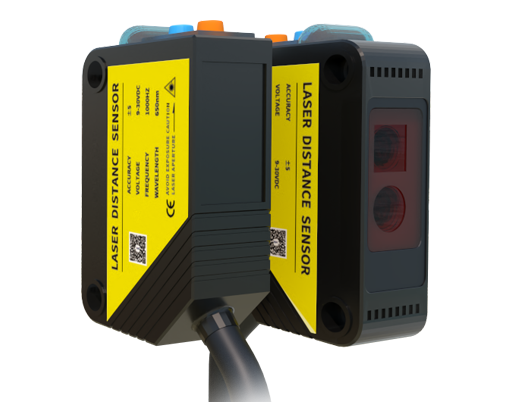
Surface characteristics of the target material, including color, reflectivity, and texture, also impact accuracy. A highly reflective surface might saturate the sensor, while a dark, absorptive surface could weaken the return signal. Modern laser sensors often feature automatic gain control (AGC) and multi-echo processing to adapt to varying reflectivities. Compensation is achieved through calibration against reference samples with known properties, enabling the sensor to adjust its output linearly across different surfaces. Some high-end models incorporate machine learning algorithms that learn surface behaviors over time, providing adaptive compensation without manual intervention.
Systematic errors, such as linearity deviations and offset errors, are addressed through rigorous calibration during production. Using precision stages and reference standards, manufacturers characterize each sensor's response curve. Compensation parameters are then embedded into the sensor's memory, allowing for real-time correction via onboard microprocessors. Field calibration is also possible using user-accessible routines, where operators can recalibrate against a master gauge to maintain accuracy after installation or maintenance.

In practice, implementing these compensation techniques requires a holistic approach. Sensor fusion, combining data from multiple sensors like inclinometers or encoders, can further enhance accuracy. For example, in coordinate measurement machines, laser sensor data is often fused with positional feedback to compensate for geometric errors in the system. Regular maintenance and software updates are essential to ensure compensation algorithms remain effective as the sensor ages.
Ultimately, the pursuit of high accuracy in laser sensing is an ongoing process of measurement, compensation, and validation. By leveraging advanced electronics, sophisticated algorithms, and proactive calibration, engineers can mitigate inherent errors and push the boundaries of precision. As industries evolve towards smarter manufacturing and tighter tolerances, the role of accuracy compensation will only grow in importance, making it a cornerstone of reliable laser sensor deployment.