In modern industrial automation, ensuring the safety of personnel working in close proximity to machinery is paramount. Safety laser scanners have emerged as a sophisticated and flexible solution for creating non-contact, two-dimensional protective fields around hazardous areas. Unlike traditional physical guards, these devices enable safe human-machine collaboration and allow for efficient material flow, making them indispensable in applications like automated guided vehicle (AGV) safety, robotic workcell monitoring, and access point safeguarding. This article delves into the core operating principles, key components, and safety standards governing these critical devices.
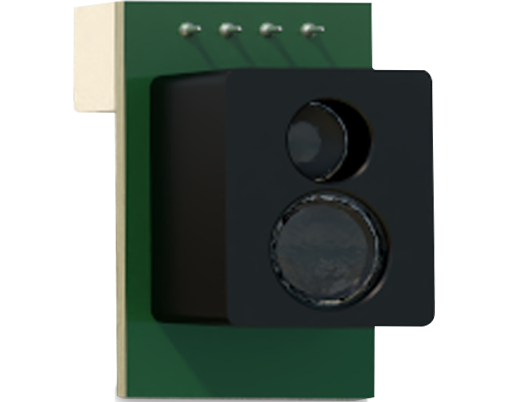
At its heart, a safety laser scanner is a type of optoelectronic protective device (AOPD). Its fundamental operation is based on time-of-flight (ToF) measurement. The scanner's core component is a rotating laser diode that emits pulsed infrared light beams in a fan-shaped plane, typically covering a 270-degree field of view. As these light pulses travel through the scanning plane, they may encounter objects. When a pulse hits an object, it is reflected back towards the scanner. A highly sensitive receiver, often a photodiode or an avalanche photodiode (APD) array, detects this reflected signal. The scanner's internal processor precisely measures the time difference between the emission of the pulse and the reception of its echo. Since the speed of light is a known constant, this time-of-flight data is used to calculate the exact distance to the object with high accuracy. By correlating this distance measurement with the known angular position of the rotating mirror at that instant, the scanner builds a detailed two-dimensional contour map of its surroundings, plotting detected objects as points in polar coordinates (distance and angle).

The true "safety" aspect is defined not just by detection, but by configurable protective and warning fields. Users can define multiple, non-overlapping zones within the scanner's range using dedicated configuration software. The most critical zone is typically the protective field. Any intrusion into this field by an object exceeding a configurable minimum size (often defined by a "resolution" or "finger test" criteria, e.g., detecting a 40mm diameter cylinder) triggers an immediate safety-related output signal. This signal is designed to transition to a safe state (e.g., open-circuit for OSSD outputs), commanding the guarded machine to stop or enter a safe mode. Surrounding the protective field, one or more warning fields can be established. An intrusion into a warning field triggers a non-safety signal, which can be used for pre-warning functions like activating an audible alarm or reducing machine speed, allowing for preventive action before a protective stop is necessary. This layered approach enhances both safety and productivity.
The reliability and fail-safe nature of these devices are governed by rigorous international standards, primarily IEC 61496 (Parts 1, 2, and 3) for electro-sensitive protective equipment and IEC 61508/IEC 62061 for functional safety. To achieve a high Safety Integrity Level (SIL 2 or SIL 3 according to IEC 61508, or Performance Level 'd'/'e' per ISO 13849), safety laser scanners incorporate extensive internal monitoring and redundancy. Key components are continuously checked for faults. This includes monitoring the laser output power, the receiver circuit sensitivity, the mirror rotation speed, the internal processor function, and the output switching circuits. Many scanners employ a dual-channel architecture where critical measurement and processing paths are duplicated and cross-compared. Any detected discrepancy or fault leads to a controlled de-energization of the safety outputs, ensuring a safe shutdown. Furthermore, the devices are designed to be highly resistant to environmental interference such as ambient light (tested against specified levels of illumination), dust, fog, and electromagnetic noise, ensuring stable operation in harsh industrial environments.
Installation and integration require careful planning. Factors such as mounting height, scanning plane alignment, range requirements, and the need for multiple scanners to cover complex areas must be considered. The configured protective fields must be validated to ensure they adequately cover the hazard zone without creating nuisance trips from permissible objects. Regular functional testing, as mandated by safety regulations, is essential to maintain the system's integrity over time. In summary, safety laser scanners provide a dynamic and intelligent guarding solution by combining precise time-of-flight laser measurement with configurable zone monitoring and high-integrity safety circuitry. Their principle of operation transforms simple distance measurements into a reliable spatial safety awareness system, enabling both protection for personnel and flexibility for modern automated processes, thereby forming a critical bridge between productivity and safety in the Industry 4.0 landscape.