Laser sensors have become indispensable tools across numerous industrial sectors, offering unparalleled precision in measurement, detection, and positioning tasks. A critical, yet often nuanced, aspect of their performance is the sensor angle—specifically, the angle of incidence and the angular field of view. This parameter fundamentally influences the accuracy, reliability, and suitability of a laser sensor for a given application.
The angle of incidence refers to the angle at which the laser beam strikes the target surface. According to the basic principles of optics, when a laser beam hits a surface at a non-perpendicular angle, the reflected beam's path and intensity change. For specular (shiny, mirror-like) surfaces, a beam striking at a high angle of incidence may reflect away from the sensor's receiver, causing a measurement error or complete signal loss. Conversely, for diffuse (matte, rough) surfaces, which scatter light in many directions, the impact is less severe, though optimal measurement conditions are still achieved with near-perpendicular incidence. Therefore, understanding the target's surface properties is paramount when considering sensor mounting and angle alignment.
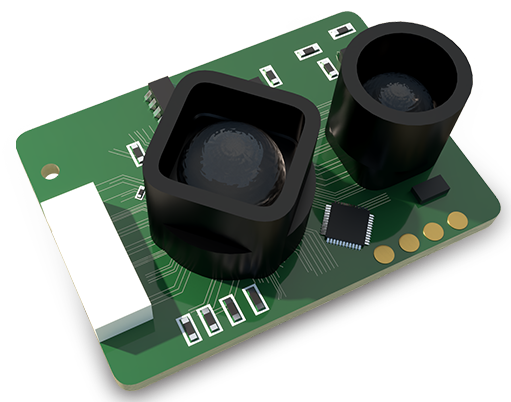
The angular field of view, often related to the receiver's optics, defines the conical region within which the sensor can detect the reflected light. A narrow field of view allows for high precision in pinpointing a specific measurement point, rejecting ambient light or reflections from nearby objects. This is crucial in applications like precision assembly or edge detection. A wider field of view, however, provides greater tolerance for misalignment, target movement, or surface irregularities, making it suitable for presence detection on conveyor belts or monitoring the fill level of bulk materials in large containers.
In practical industrial settings, the correct management of laser sensor angles directly impacts system performance. For example, in automated welding, a laser displacement sensor must be mounted at an angle that avoids interference from the intense welding arc while still accurately tracking the seam profile. In logistics, barcode scanners use specific angular configurations to ensure the laser sweeps across the label effectively, regardless of package orientation on a fast-moving line. Furthermore, in safety systems like light curtains, the precise angular alignment of multiple laser beams creates an invisible protective field; any misalignment can create dangerous gaps.
Several advanced techniques help mitigate challenges related to angle. Some sensors incorporate coaxial optics, where the emitter and receiver are aligned along the same axis, minimizing the triangulation error and allowing reliable measurement on various surface types. Others feature adjustable mounting brackets or built-in software for angle compensation. The emergence of multi-point sensors and laser line profilers, which project a line instead of a single dot, effectively captures profile data across a range of angles simultaneously, simplifying the measurement of complex geometries.
When selecting and installing a laser sensor, engineers must conduct a thorough analysis of the application's angular requirements. Key considerations include the target's surface finish, possible movement or vibration, required measurement resolution, and environmental factors like ambient light or dust. A sensor perfectly calibrated in a lab may fail on the factory floor if the operational angles are not accounted for. Proper installation, followed by verification and testing under real conditions, is essential to ensure the sensor performs as intended, delivering the high accuracy and robustness expected in modern industrial automation.
Ultimately, the angle is not merely a technical specification but a fundamental design variable. Mastering its implications allows engineers to unlock the full potential of laser sensing technology, enhancing efficiency, quality control, and safety across manufacturing, robotics, and material handling applications. As sensor technology evolves with smarter algorithms and more adaptive optics, the precise control and utilization of angular characteristics will continue to drive innovation in industrial measurement and automation.