In the rapidly evolving landscape of industrial automation and precision measurement, strong penetration laser sensors have emerged as a cornerstone technology. These advanced devices utilize high-intensity, focused laser beams capable of penetrating challenging mediums such as smoke, dust, steam, and certain translucent materials to deliver reliable and accurate data. Unlike conventional optical sensors that falter in obscured environments, strong penetration lasers maintain signal integrity, making them indispensable for applications where visibility is compromised.
The core principle hinges on the laser's coherent light properties and specific wavelength selection. Typically operating in the infrared spectrum, these sensors emit a concentrated beam that can pass through interfering particulates with minimal scattering or absorption. The receiver unit is finely tuned to detect the specific wavelength of the emitted laser, effectively filtering out ambient light and background noise. This allows for precise measurement of distance, presence, thickness, or vibration even in conditions that would render other sensing technologies ineffective.
Key applications span a diverse range of demanding industries. In heavy manufacturing and metal processing, these sensors perform continuous level monitoring of molten materials in furnaces, where intense heat and rising fumes are constant challenges. In the lumber and wood processing industry, they accurately measure the thickness of boards through sawdust clouds. Mining operations deploy them for vehicle detection and collision avoidance in dusty tunnels. Furthermore, they are critical in chemical plant environments for monitoring processes involving vapors and aerosols, ensuring safety and operational continuity.

The advantages are multifaceted. First and foremost is reliability. The ability to function consistently in low-visibility conditions drastically reduces system downtime and false triggers. Second is precision. High-resolution measurements are maintained, supporting quality control in sensitive processes. Third is versatility. With various models offering different ranges, penetration capabilities, and output signals, they can be integrated into complex control systems like PLCs and SCADA networks. Modern iterations also feature robust housings with high IP ratings, ensuring resilience against moisture, vibration, and extreme temperatures.
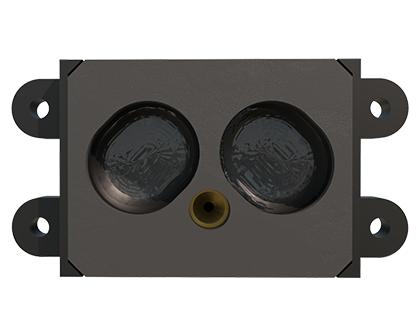
When selecting a strong penetration laser sensor, engineers must consider several parameters. The required sensing range and the density of the penetrating medium dictate the necessary laser power and receiver sensitivity. The response time is crucial for high-speed applications. The type of output—analog (4-20 mA, 0-10 V), digital (PNP/NPN), or serial communication (RS-485, IO-Link)—must align with the existing control architecture. Additionally, form factor and mounting options are vital for integration into space-constrained machinery.
Installation and alignment, while straightforward, require attention. The sensor must be positioned to ensure the laser path is as clear as possible, minimizing the distance through the obscuring medium. Regular maintenance involves cleaning the lens surfaces to prevent buildup that could attenuate the signal, although the penetration capability often reduces the frequency of cleaning compared to standard optical sensors.
Looking ahead, the integration of smart features is set to enhance their value proposition. Embedded diagnostics, predictive maintenance alerts, and advanced data processing capabilities are becoming standard. The convergence with Industrial Internet of Things (IIoT) platforms allows for real-time data analytics and remote monitoring, paving the way for more predictive and adaptive industrial systems.
In conclusion, strong penetration laser sensors represent a critical leap forward in sensing technology. By overcoming the traditional limitations of optical measurement in hostile environments, they provide a reliable, accurate, and robust solution that underpins efficiency, safety, and quality in modern industry. Their continued development will be integral to the advancement of fully autonomous and resilient industrial operations.