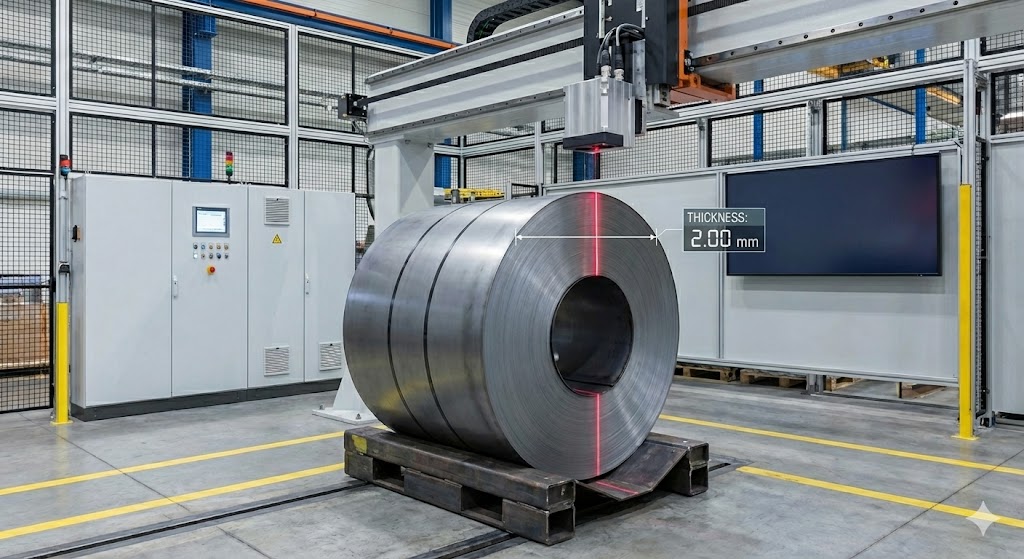
Laser area sensors represent a significant advancement in industrial sensing technology, offering a robust solution for high-precision, non-contact measurement and inspection across a wide range of applications. Unlike traditional single-point laser sensors or line lasers, these devices project a two-dimensional laser profile—essentially a plane or sheet of light—onto a target object. A high-resolution CMOS or CCD camera, positioned at a known angle relative to the laser emitter, captures the deformation or displacement of this laser line. Sophisticated triangulation algorithms then process this image data to generate a detailed 2D or 3D profile of the object's surface, providing precise height, width, depth, and contour information.
The core operational principle is laser triangulation. The sensor's laser diode emits a focused fan-shaped beam. When this line intersects with an object, its shape is distorted based on the object's surface topography. The camera, offset from the laser source, views this line from a different perspective. By analyzing the precise pixel position of the laser line in the camera's field of view, the sensor's processor can calculate the exact distance to each point along the line using trigonometric relationships. This process, repeated at high speeds, allows for real-time profiling of objects moving on a conveyor or under static inspection.
Key advantages of laser area sensors drive their adoption in demanding industrial environments. First, they provide rich data density, capturing thousands of measurement points in a single scan, which is invaluable for complex shape verification and defect detection. Second, their non-contact nature eliminates mechanical wear and prevents damage to delicate products. They are highly immune to ambient light variations when compared to conventional vision systems, thanks to the use of a narrow-band laser and optical filters. Furthermore, they offer exceptional resolution and repeatability, often in the micron range, making them suitable for stringent quality control tasks.
In practical industrial applications, laser area sensors are indispensable. In automotive manufacturing, they are used for precise gap and flush measurement between body panels, weld seam inspection, and tire tread profiling. In electronics assembly, they verify component coplanarity (e.g., BGA balls), measure solder paste height, and inspect connector pin alignment. The packaging industry relies on them for checking fill levels, detecting seal integrity, and measuring package dimensions. In logistics and warehousing, they facilitate parcel dimensioning (DWS systems) and pallet profiling for automated storage and retrieval systems.
Selecting the appropriate laser area sensor requires careful consideration of several technical parameters. Measurement range and field of view (FOV) must align with the target object's size and required coverage. Resolution and repeatability specifications must meet the application's tolerance requirements. The scanning speed or profile rate must be high enough to maintain throughput without sacrificing data quality, especially for fast-moving production lines. Environmental factors are critical; sensors rated with high IP codes (e.g., IP67) are necessary for washdown or dusty environments. The type of output (e.g., analog, Ethernet/IP, PROFINET) must integrate seamlessly with the existing PLC or control system. Finally, the software interface plays a vital role; user-friendly configuration tools, robust data analysis libraries, and easy-to-set inspection routines significantly reduce deployment time and complexity.
Integration typically involves mounting the sensor securely, calibrating it for the specific working distance and angle, and configuring the inspection program within the accompanying software. Modern sensors often feature intuitive teach-in functions to define pass/fail thresholds based on a known good sample. Data can be output as a complete profile, extracted measurement values, or simple OK/NG signals for sorting or rejection mechanisms.
Looking ahead, the evolution of laser area sensors is geared towards smarter, more compact, and more integrated solutions. The integration of AI and machine learning directly at the sensor edge will enable more advanced anomaly detection and classification without relying on external PCs. Miniaturization will allow their deployment in tighter spaces, such as within robotic end-effectors. Enhanced communication protocols will further simplify integration into Industry 4.0 and IIoT frameworks, facilitating predictive maintenance and centralized data analytics across the factory floor.
In conclusion, laser area sensors are powerful tools that bridge the gap between simple presence detection and complex 3D vision systems. Their ability to deliver precise, high-density profile data in real-time makes them a cornerstone technology for modern automated inspection, measurement, and guidance tasks. By understanding their operating principles, key benefits, and selection criteria, engineers and system integrators can effectively leverage these sensors to enhance product quality, optimize processes, and drive efficiency in automated manufacturing and logistics operations.