Proximity sensors are essential components in modern industrial automation, robotics, and safety systems, designed to detect the presence or absence of objects within a specified range without physical contact. Their structural design directly influences accuracy, reliability, and application suitability. This analysis delves into the key structural elements of common proximity sensor types, focusing on inductive, capacitive, and ultrasonic variants, while adhering to industry standards and engineering principles.
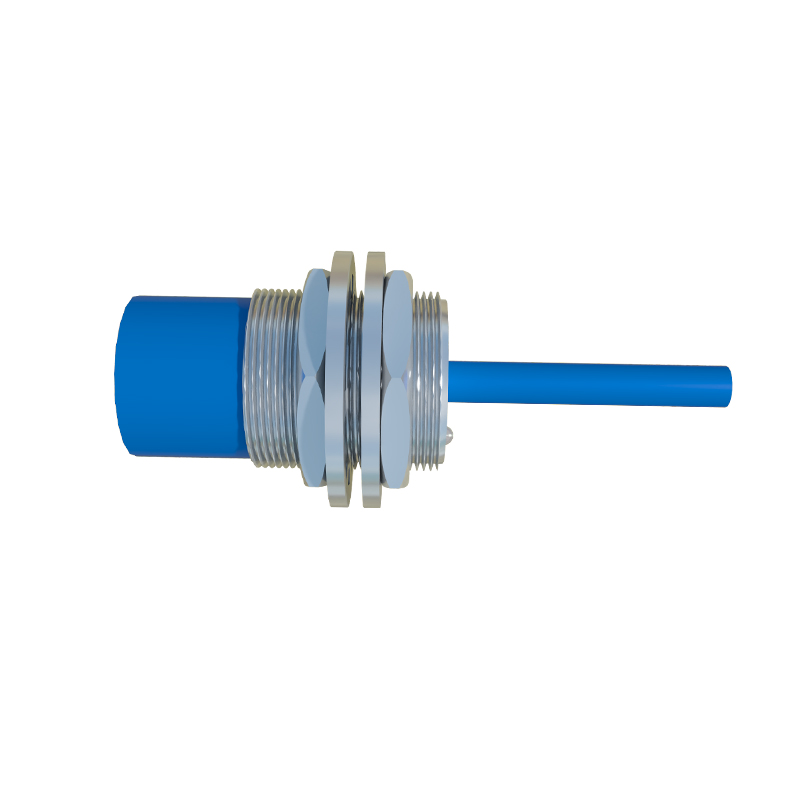
The core of an inductive proximity sensor comprises an oscillator coil, ferrite core, detection circuit, and output stage, typically housed in a robust metal or polymer casing. The oscillator generates a high-frequency electromagnetic field at the active face. When a metallic object enters this field, eddy currents are induced, causing a change in oscillation amplitude. This alteration is detected by the subsequent circuit, triggering a solid-state switch output. Structurally, the coil winding precision and core material—often ferrite for high permeability—are critical for sensitivity and temperature stability. The housing must provide electromagnetic shielding to minimize interference from adjacent machinery, with IP67 or higher ratings common for dust and water resistance in harsh environments.
Capacitive proximity sensors share a similar housing approach but differ internally. They feature a sensing electrode connected to an oscillator, a reference electrode, and a detection circuit. The electrode configuration forms a capacitor where the target object alters the dielectric constant, changing capacitance and thus oscillation. Structurally, these sensors often incorporate guard rings around the sensing electrode to direct the electric field and reduce false triggers from non-target materials. The housing material, such as PTFE or polypropylene, is selected for chemical resistance and minimal dielectric interference, enabling detection of non-metallic objects like liquids or plastics. Key design challenges include managing stray capacitance and ensuring consistent performance across varying environmental humidities.
Ultrasonic proximity sensors employ a more complex structure, integrating a piezoelectric transducer (transmitter and receiver), control electronics, and an acoustic housing. The transducer emits high-frequency sound pulses; upon hitting an object, echoes return to the receiver. Time-of-flight calculations determine distance. Structurally, the transducer’s ceramic element must be precisely mounted to minimize damping, while the housing includes an acoustic lens or mesh to focus sound waves and protect against contaminants. Internal damping materials absorb internal reflections to prevent signal noise. These sensors often feature temperature compensation circuits, as sound speed varies with air density, highlighting the importance of integrated thermal sensors in the design.
Across all types, structural integrity hinges on component alignment, material selection, and environmental sealing. For instance, inductive sensors use epoxy potting to secure internal components against vibration, while capacitive variants may employ O-rings for sealing. Connector types, such as M12 or M8 threaded conduits, are standardized for easy integration into control systems. Advanced designs incorporate self-diagnostic LEDs and programmable logic directly into the housing, reducing external wiring.
In summary, the structure of a proximity sensor is a tailored assembly of electromagnetic or acoustic elements, protective housing, and signal processing units. Engineers must balance detection range, response time, and environmental robustness, with trends leaning toward miniaturization and smart sensor fusion. Understanding these structural nuances enables optimal selection for applications ranging from conveyor belt monitoring to precision assembly lines, ensuring efficient and safe industrial operations.