Laser displacement sensors are non-contact measurement devices that utilize laser triangulation or time-of-flight principles to determine the distance to a target object with high precision. Their ability to perform rapid, accurate measurements without physical contact makes them indispensable in industries like manufacturing, robotics, and automation. Understanding the different types is crucial for selecting the right sensor for a specific application.
The most common and widely used type is the Laser Triangulation Sensor. This sensor operates by projecting a laser spot onto the target surface. The reflected light is focused onto a position-sensitive detector (PSD or CMOS/CCD). As the target distance changes, the position of the reflected spot on the detector shifts. Using trigonometric calculations, the sensor's controller determines the exact distance. These sensors offer excellent resolution and accuracy for short to medium ranges, typically from a few millimeters up to about one meter. They are ideal for measuring displacement, thickness, vibration, and profile of objects in controlled environments. However, their performance can be affected by the target's color, reflectivity, and surface texture.
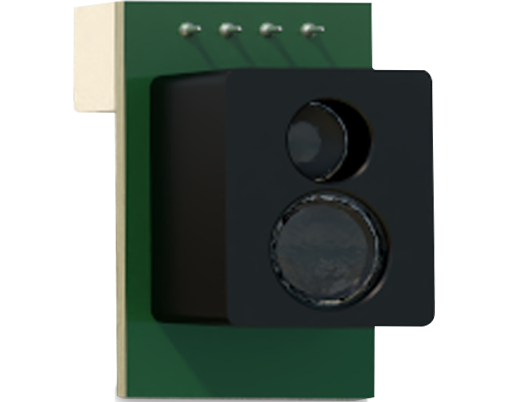
For applications requiring measurements over much longer distances, Time-of-Flight (ToF) Laser Sensors are the preferred choice. Also known as laser rangefinders, these sensors calculate distance by measuring the time it takes for a laser pulse to travel to the target and back. The formula Distance = (Speed of Light × Time) / 2 is applied. ToF sensors can measure ranges from several meters to hundreds of meters. They are less sensitive to surface properties like color and finish compared to triangulation sensors but generally offer lower resolution and accuracy at close range. Common applications include vehicle navigation, large-scale surveying, level monitoring in silos, and crane positioning.

A specialized variant is the Confocal Chromatic Sensor. This type uses a multi-lens optical system to focus polychromatic (white) light onto the target. Different wavelengths of light are focused at different distances along the measurement axis. Only the wavelength that is perfectly focused on the target surface is reflected back through the system to a spectrometer, which analyzes the color and correlates it to a precise distance. The key advantage is the ability to measure on transparent, reflective, or highly curved surfaces (e.g., glass, polished metal, lenses) where standard laser triangulation fails. They provide high precision for micron-level measurements in semiconductor and optical industries.
Another important category is the Laser Profile Sensor or Line Laser Scanner. Instead of a single point, these sensors project a laser line onto an object. A camera captures the deformation of this line, and sophisticated software generates a detailed 2D or 3D cross-sectional profile of the target. This enables measurement of complex geometries, contours, edge positions, and surface defects. They are extensively used for inspection tasks, such as checking weld seams, tire treads, or electronic component coplanarity.
Selecting the appropriate laser displacement sensor involves careful consideration of several parameters. Measurement Range and Stand-off Distance define the working envelope. Resolution and Accuracy specify the sensor's capability to detect minute changes and its trueness to the actual value. Sampling Speed or frequency determines how fast measurements can be taken, critical for dynamic or high-speed processes. The Target Surface characteristics (color, material, texture, transparency) heavily influence the choice between triangulation, confocal, or ToF technologies. Finally, environmental factors like ambient light, dust, vibration, and temperature must be accounted for, often necessitating sensors with robust housings and protective ratings.
In conclusion, the landscape of laser displacement sensors is diverse, with each type engineered to excel in specific scenarios. Triangulation sensors dominate general-purpose precision measurement, ToF sensors cover long-range needs, confocal sensors handle difficult materials, and profile scanners capture complex shapes. A thorough analysis of the application requirements against the sensor specifications is the definitive path to a successful implementation, ensuring reliability, accuracy, and efficiency in automated measurement systems.