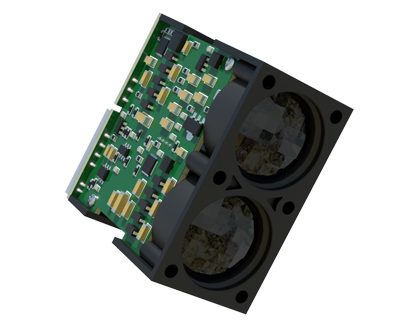
Distance measurement laser sensors represent a cornerstone technology in modern industrial automation, quality control, and robotics. These devices operate on the principle of emitting a focused beam of laser light toward a target and analyzing the reflected signal to calculate the distance with high precision. Unlike traditional contact measurement tools, they offer non-contact, high-speed, and accurate readings, making them indispensable in environments where physical contact is impossible or undesirable.
The core working principle can be categorized mainly into two types: time-of-flight (ToF) and triangulation. Time-of-flight sensors measure the time it takes for a laser pulse to travel to the target and back. Given the constant speed of light, the distance is calculated directly from this time interval. This method is excellent for long-range measurements, from several meters to hundreds of meters, and is commonly used in applications like aerial surveying, forestry, and large-scale warehouse automation.
Triangulation-based laser sensors, on the other hand, are ideal for short to medium ranges with exceptional accuracy, often down to the micrometer level. Here, a laser diode projects a spot onto the target. The reflected light is focused onto a position-sensitive detector (like a CCD or PSD) at a known angle. As the target distance changes, the position of the light spot on the detector shifts. Using trigonometric calculations, the sensor's processor determines the exact distance. This method is prevalent in precision manufacturing for tasks such as thickness gauging, wafer inspection, and component positioning.

Choosing the right laser distance sensor depends heavily on the application's specific requirements. Key parameters to consider include measurement range, accuracy, resolution, response time, and the properties of the target surface. For instance, a shiny or highly reflective surface can saturate the receiver, while dark or absorbent materials may return too weak a signal. Many modern sensors incorporate advanced algorithms and adjustable settings to compensate for varying surface conditions, ensuring reliable performance.
The applications of these sensors are vast and growing. In industrial automation, they are used for precise positioning of robotic arms, controlling fill levels in containers, and monitoring conveyor belt processes. In the automotive industry, they assist in assembly line robotics and vehicle dimension verification. Beyond manufacturing, they play critical roles in construction for leveling and alignment, in agriculture for yield monitoring, and in consumer electronics, enabling features like gesture recognition in devices.

When integrating a laser distance sensor, environmental factors must be accounted for. Ambient light, dust, fog, or temperature extremes can affect performance. Selecting sensors with appropriate ingress protection (IP) ratings and robust housing is crucial for harsh industrial environments. Furthermore, compliance with laser safety classes (typically Class 1 or Class 2 for industrial sensors) is mandatory to ensure operator safety.
The future of distance measurement laser sensors points towards even greater miniaturization, lower power consumption, and enhanced intelligence. Integration with Industrial Internet of Things (IIoT) platforms allows for predictive maintenance and real-time data analytics, transforming raw distance data into actionable insights. As technology advances, these sensors will continue to push the boundaries of precision and reliability, enabling new levels of automation and efficiency across countless sectors. For engineers and system integrators, understanding the fundamental principles and selection criteria is the first step toward leveraging this powerful technology effectively.