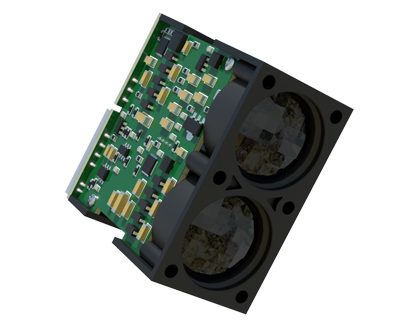
In the rapidly evolving landscape of industrial automation and precision measurement, interventional laser sensors have emerged as a cornerstone technology, offering unparalleled accuracy, reliability, and versatility. These advanced sensors utilize laser beams to detect, measure, or monitor physical parameters such as distance, displacement, thickness, and vibration in real-time, often in challenging environments where traditional sensing methods fall short. Unlike non-contact sensors that operate from a distance, interventional laser sensors are designed to interact directly or closely with the target or process, enabling high-precision interventions in manufacturing, quality control, and safety systems.
The core principle behind interventional laser sensors is based on laser triangulation, time-of-flight (ToF), or interferometry techniques. In triangulation, a laser diode projects a focused beam onto the target surface, and the reflected light is captured by a position-sensitive detector. Any change in the target's position alters the angle of reflection, allowing the sensor to calculate precise distance measurements with micron-level resolution. This method is particularly effective in applications like robotic guidance, where exact positioning is critical for assembly tasks. Time-of-flight sensors, on the other hand, measure the round-trip time of a laser pulse to determine distance, making them ideal for long-range sensing in logistics or automotive industries. Interferometric sensors exploit wave interference patterns to detect minute displacements, often used in semiconductor manufacturing or scientific research for nanometer-scale accuracy.
One of the key advantages of interventional laser sensors is their ability to operate in harsh conditions, including high temperatures, dust, and vibrations, without compromising performance. For instance, in the steel industry, these sensors are deployed to monitor roll gaps and strip thickness during hot rolling processes, ensuring consistent product quality while reducing material waste. In automotive production lines, they facilitate precise weld inspection and component alignment, enhancing safety and efficiency. Additionally, in the medical field, interventional laser sensors are integrated into surgical devices for real-time tissue analysis or minimally invasive procedures, showcasing their cross-industry applicability.
The integration of smart features, such as IoT connectivity and AI-driven analytics, has further expanded the capabilities of interventional laser sensors. Modern sensors can transmit data to centralized control systems, enabling predictive maintenance and adaptive process adjustments. For example, in smart factories, these sensors contribute to Industry 4.0 initiatives by providing continuous feedback loops that optimize production throughput and minimize downtime. However, challenges remain, including calibration complexities, sensitivity to environmental factors like ambient light, and higher initial costs compared to conventional sensors. Ongoing research focuses on developing more robust algorithms and cost-effective designs to address these limitations.

Looking ahead, the future of interventional laser sensors is poised for growth with advancements in miniaturization, multi-sensor fusion, and quantum sensing technologies. As industries demand greater precision and automation, these sensors will play a pivotal role in enabling next-generation applications, from autonomous vehicles to precision agriculture. Engineers and technicians must stay abreast of these trends, leveraging interventional laser sensors to drive innovation and operational excellence. In summary, interventional laser sensors represent a transformative tool in the electrical and industrial sectors, combining cutting-edge optics with practical intervention capabilities to meet the rigorous demands of modern technology.