Green laser sensors represent a significant advancement in photoelectric sensing technology, offering unique advantages in precision measurement, alignment, and detection across various industrial sectors. Unlike traditional red laser sensors, green laser sensors operate at a wavelength of approximately 532 nanometers, which falls within the visible spectrum. This characteristic makes them particularly effective in applications requiring high visibility and accuracy, such as semiconductor manufacturing, automotive assembly, and quality control processes.
The fundamental principle of green laser sensors is based on the emission of coherent light through a process involving diode-pumped solid-state (DPSS) lasers. In a typical green laser sensor, an infrared laser diode pumps a neodymium-doped crystal, such as neodymium-doped yttrium orthovanadate (Nd:YVO4), to produce light at 1064 nanometers. This infrared light then passes through a frequency-doubling crystal, like potassium titanyl phosphate (KTP), which converts it to 532-nanometer green light through second-harmonic generation. The resulting green laser beam is highly collimated and focused, enabling precise targeting with minimal divergence over long distances.
In industrial settings, green laser sensors are commonly used for triangulation-based distance measurement. The sensor projects a green laser spot onto a target surface, and a CMOS or CCD detector captures the reflected light at an angle. By analyzing the position of the reflected spot on the detector, the sensor calculates the distance to the target with micron-level accuracy. This method is ideal for measuring small objects, detecting surface defects, or monitoring dimensional tolerances in real-time. Additionally, the high contrast of green light against most materials enhances signal clarity, reducing errors caused by ambient light interference.
Another key application is in alignment and positioning systems, where green lasers provide a visible reference line or dot for machinery calibration. For instance, in CNC machining or robotic welding, green laser sensors guide tool paths by projecting patterns onto workpieces, ensuring precise alignment without physical contact. The visibility of the green beam allows operators to visually verify setups, improving efficiency and reducing downtime. Moreover, green lasers are less prone to scattering in certain environments compared to red lasers, making them suitable for use in dusty or humid conditions common in factories.
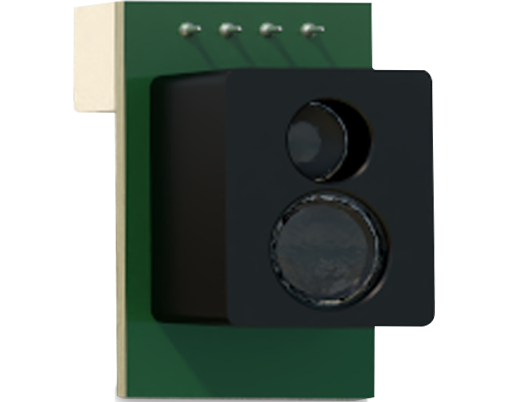
Safety considerations are paramount when deploying green laser sensors. Although they are generally classified as Class 2 or Class 3R lasers, depending on power output, proper shielding and operator training are necessary to prevent eye exposure. Industrial models often include built-in safety features like automatic power reduction and interlock systems to comply with international standards such as IEC 60825.

The evolution of green laser sensor technology continues to drive innovation in automation and Industry 4.0. With advancements in miniaturization and energy efficiency, these sensors are becoming more integrated into smart manufacturing systems, enabling real-time data collection and adaptive control. As industries demand higher precision and reliability, green laser sensors are poised to play a crucial role in enhancing productivity and quality assurance.
In summary, green laser sensors leverage specific optical properties to deliver superior performance in demanding industrial applications. Their ability to provide clear, accurate measurements and alignments makes them indispensable tools in modern engineering, supporting trends toward automation and precision manufacturing. Future developments may focus on expanding wavelength ranges and integrating AI-driven analytics for even smarter sensing solutions.
