In the realm of industrial automation, proximity switches are indispensable components for non-contact detection of objects. A fundamental parameter defining their performance and application suitability is the sensing distance, often referred to as the nominal sensing distance (Sn). This distance is not a fixed, absolute value but a carefully specified range under defined standard conditions, typically involving a standard target. Understanding the nuances of this specification is critical for engineers to ensure reliable system operation.
The nominal sensing distance, as stated on a sensor's datasheet, is measured under ideal laboratory conditions: at a rated operating voltage, within a specified ambient temperature (usually 20-25°C), and using a defined standard target. For inductive proximity sensors, this target is typically a square of mild steel (Fe 360) with a side length equal to the sensor's sensing face diameter or three times the nominal sensing distance, whichever is greater. For capacitive sensors, the target is often a grounded metal plate. It is crucial to recognize that this is a theoretical reference point. The effective operating distance in a real-world installation will always be less than or equal to this nominal value due to various influencing factors.
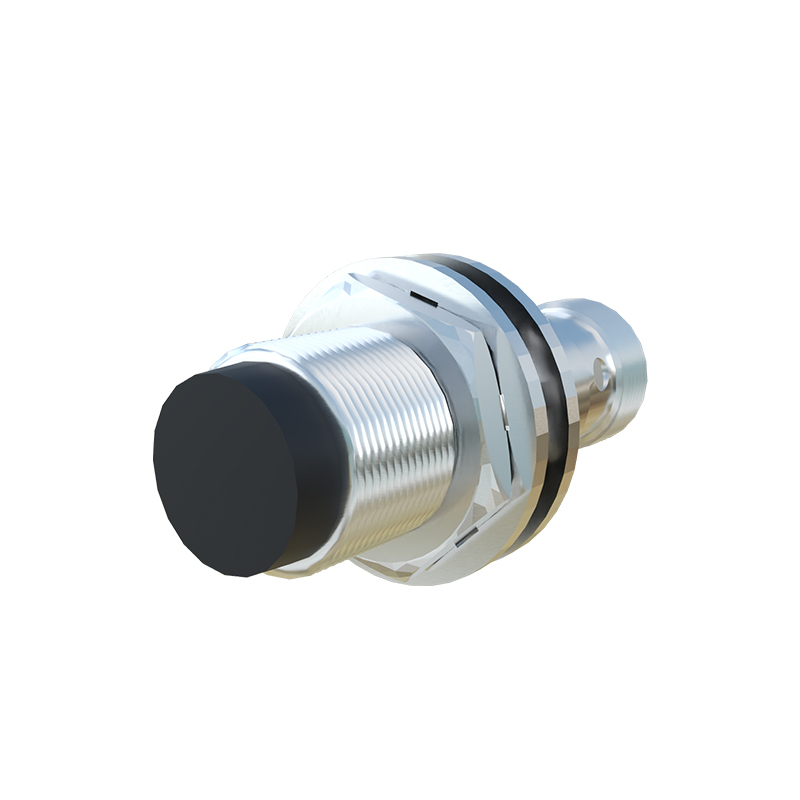
Several key factors directly impact the actual achievable sensing distance in practice. First, the target material is paramount, especially for inductive sensors. While the nominal distance is given for mild steel, other metals have correction factors. For instance, stainless steel (austenitic) may reduce the sensing distance to approximately 0.7-0.8 times Sn, brass to about 0.4-0.5 times Sn, and aluminum to 0.3-0.4 times Sn. Capacitive sensors are less affected by material type but are highly sensitive to material density and dielectric constant. Second, the target size and shape matter. A target smaller than the standard specified size will result in a reduced sensing range. The shape also influences the electromagnetic field interaction; flat, smooth surfaces are optimal. Third, environmental conditions play a significant role. High ambient temperatures can decrease the sensing distance, as can the presence of strong electromagnetic fields from nearby motors or welding equipment. For capacitive sensors, humidity, dust, and contaminants on the sensing face can alter the dielectric environment and affect performance.
Beyond the nominal distance, two other critical distances are defined in proximity switch specifications: the assured operating distance (Sa) and the assured release distance (Sr). The assured operating distance is a guaranteed range, usually 0 to 0.81 times Sn, within which the sensor is guaranteed to detect an approaching target and switch its output state reliably. This built-in safety margin accounts for manufacturing tolerances, supply voltage fluctuations (typically within ±10%), and expected temperature variations. The assured release distance is the point beyond which the sensor is guaranteed to return to its normal state once the target has moved away. Understanding the hysteresis—the difference between the switch-on and switch-off points—is vital for preventing output oscillation when a target is positioned at the very edge of the detection zone.
Selecting the correct sensing distance for an application involves more than just matching the nominal value to a physical gap. Engineers must calculate the effective sensing distance by applying correction factors for the actual target material and size. A critical design rule is to derate the nominal sensing distance. A common practice is to use only 60-80% of the nominal Sn for the application's required mechanical gap. This derating provides a safety buffer against the aforementioned influencing factors, ensuring detection reliability even under non-ideal conditions. For example, if a machine requires a 10mm gap between the sensor and a stainless steel target, selecting a sensor with a nominal sensing distance of 15mm or more (applying material and safety derating) would be prudent.
Applications heavily rely on these principles. In high-speed packaging lines, precise and repeatable sensing distances are necessary for accurate object counting and positioning. In robotic end-effectors, sensors with very short, precise sensing distances are used for delicate part presence verification. In harsh environments like metal stamping presses, sensors with extended sensing distances might be chosen to account for potential buildup of metallic debris on the sensing face, while still maintaining detection of the primary target.
In conclusion, the sensing distance of a proximity switch is a deceptively simple specification that encompasses a complex interplay of physics, material science, and environmental engineering. A deep understanding of nominal versus effective distance, the impact of target characteristics, and the importance of design derating is essential. By meticulously considering these factors, engineers can leverage proximity sensors to build robust, reliable, and efficient automated systems, ensuring that the right switch is used at the right distance for the right task.