Laser displacement fiber sensors represent a significant advancement in precision measurement technology, widely adopted across manufacturing, automation, and quality control sectors. These sensors utilize laser light transmitted through optical fibers to measure distance, position, or displacement with high accuracy and reliability. The core principle involves emitting a laser beam toward a target surface; the reflected light is captured and analyzed to determine changes in position. Unlike traditional contact-based measurement tools, laser displacement fiber sensors offer non-contact operation, eliminating mechanical wear and minimizing interference with delicate or moving objects.
One of the key advantages of laser displacement fiber sensors is their exceptional resolution, often achieving micrometer or even nanometer-level precision. This makes them ideal for applications requiring fine-tuned measurements, such as semiconductor wafer alignment, automotive component inspection, and robotics positioning. The integration of optical fibers enhances flexibility, allowing sensors to be deployed in confined or hazardous environments where direct laser emission might be impractical. Fiber optics also enable multiplexing, where multiple sensing points can be monitored using a single laser source, reducing system complexity and cost.
In industrial settings, these sensors contribute to improved efficiency and product quality. For instance, in assembly lines, they monitor part dimensions in real-time, detecting deviations that could lead to defects. In vibration analysis, laser displacement fiber sensors track minute movements of machinery, aiding in predictive maintenance and preventing downtime. Their fast response times—often in the millisecond range—support high-speed processes, such as printing or packaging, where rapid adjustments are crucial.
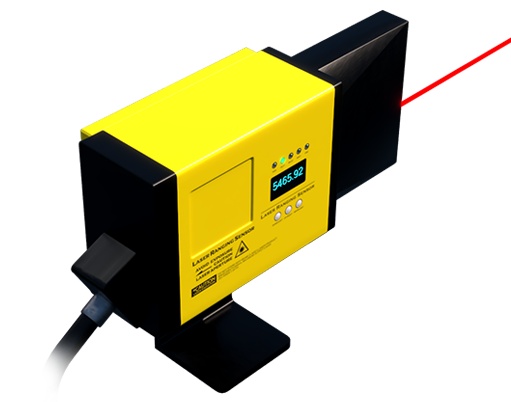
Despite their benefits, selecting the right laser displacement fiber sensor requires consideration of factors like target material, surface reflectivity, and environmental conditions. Dark or rough surfaces may scatter light, affecting accuracy, while ambient light or temperature fluctuations can introduce noise. Modern sensors incorporate advanced features like automatic gain control, filtering algorithms, and calibration protocols to mitigate these issues. Additionally, compatibility with industrial communication protocols (e.g., Ethernet/IP, PROFINET) facilitates seamless integration into automated systems.
Looking ahead, innovations in laser technology and fiber optics continue to expand the capabilities of these sensors. Developments in wavelength tuning and signal processing are enhancing performance in challenging applications, such as measuring transparent materials or operating in extreme temperatures. As industries embrace Industry 4.0 and smart manufacturing, laser displacement fiber sensors are poised to play a pivotal role in enabling precise, data-driven decision-making. By offering a blend of accuracy, durability, and adaptability, they remain a cornerstone tool for engineers striving to optimize processes and ensure quality in an increasingly automated world.