Capacitive proximity sensors are versatile and reliable components found in countless industrial, commercial, and consumer applications. Unlike their inductive counterparts that detect only metals, capacitive sensors can detect a wide range of materials, including liquids, plastics, glass, wood, and granular substances. Their fundamental operation is based on the principle of capacitance change, making them indispensable for tasks requiring non-contact detection of both conductive and non-conductive targets.
At its core, a capacitive sensor functions like an open capacitor. The sensor's active surface, or sensing face, forms one electrode. The target object forms or influences the other electrode. An oscillator circuit generates an electrostatic field emanating from the sensor face. When a target enters this detection field, it alters the dielectric properties of the space between the sensor and the ground potential. This intrusion causes a change in the capacitance of the system. The sensor's internal circuitry continuously monitors this capacitance. Once the change exceeds a predefined threshold—the sensing distance or setpoint—the sensor triggers a switching action, typically changing the state of its output signal (e.g., from OFF to ON). This output can then be used to control machinery, trigger alarms, or send data to a control system like a PLC.
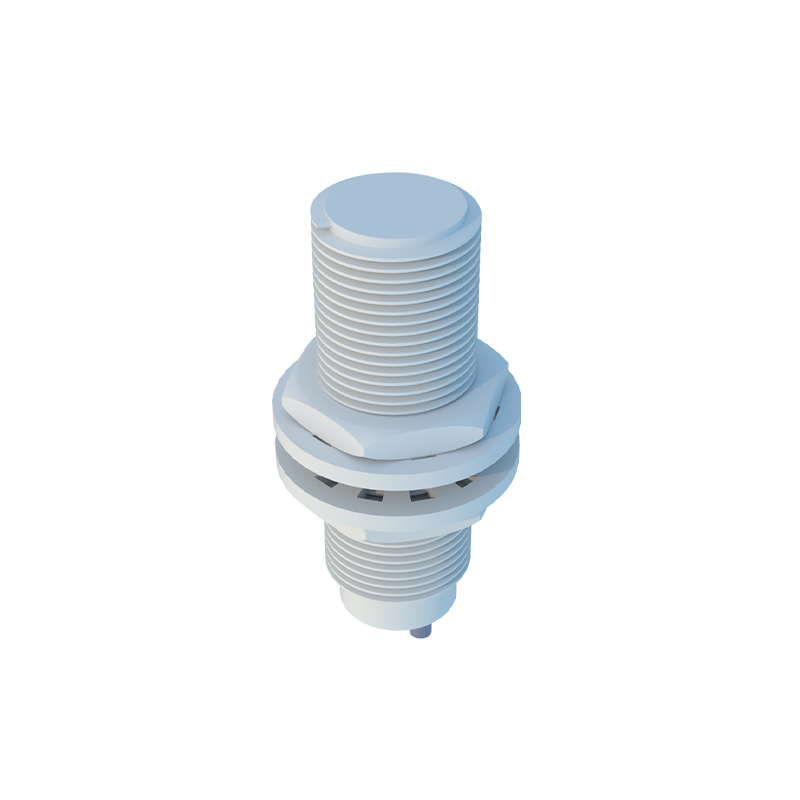
The adjustable sensitivity is a key feature. By turning a potentiometer, users can fine-tune the sensor's response. This allows compensation for different target materials, sizes, or challenging environmental conditions like dust or moisture on the sensor face. For instance, detecting a thin plastic film requires higher sensitivity than detecting a metal tank. This adjustability also enables applications like level detection through non-metallic container walls, where the sensor is mounted externally and detects the presence or absence of material inside.
The applications for capacitive proximity sensors are vast and critical to modern automation. A primary use is level detection and control. They are perfect for monitoring powder levels in silos, liquid levels in tanks (even through glass or plastic walls), and detecting the presence of granules in hoppers. In packaging and material handling, they ensure presence/absence verification. They can detect whether a bottle has a cap, if a box on a conveyor is present, or if a label has been applied to a product. Their ability to sense through certain materials makes them ideal for these non-invasive checks.
Another significant area is in the consumer electronics industry, where they enable touch-sensitive interfaces. The touchscreens on smartphones, tablets, and appliances often use a matrix of microscopic capacitive sensors. Similarly, touch-sensitive buttons and sliders on control panels replace mechanical parts, increasing reliability and enabling sleek, sealed designs resistant to liquids and contaminants.
In manufacturing and assembly, capacitive sensors perform precise object counting and position verification. They can count tablets in pharmaceutical blisters, verify the correct placement of components on a circuit board, or ensure a gasket is present before assembly proceeds. Their robustness allows them to operate in harsh environments where optical sensors might fail due to dirt or fog.
When selecting a capacitive sensor, several factors must be considered. The sensing distance is nominal and can be reduced for non-conductive materials. The target material and size directly affect performance; larger, more conductive targets are detected more easily. Environmental factors such as extreme temperatures, humidity, or the presence of conductive dust can influence operation, though many sensors are housed in rugged, IP-rated enclosures for protection. Finally, the output type (e.g., NPN, PNP, analog, or IO-Link) must be compatible with the control system.
In summary, capacitive proximity sensors act as the "touchless fingertips" of automation. Their primary function is to detect the presence, absence, or proximity of an object without physical contact, based on disturbances in an electrostatic field. This simple yet powerful principle enables solutions for level control, touch interfaces, quality verification, and process automation across diverse industries. Their adaptability to different materials and conditions ensures they remain a fundamental and growing technology in the landscape of industrial sensors and smart devices.