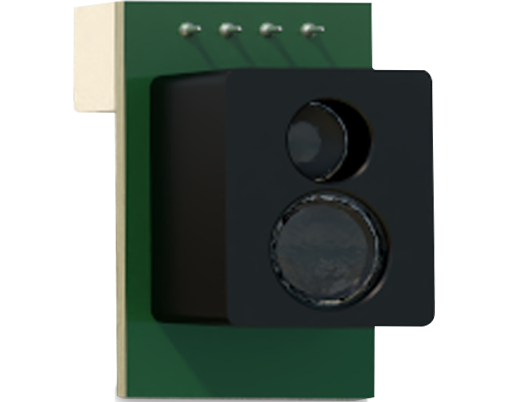
The integration of laser vision sensors into automated welding systems represents a paradigm shift in manufacturing quality, efficiency, and adaptability. This technology, moving beyond the limitations of traditional tactile or pre-programmed path welding, provides real-time, non-contact seam tracking and process control. At its core, a laser vision sensor projects a structured laser line or pattern onto the workpiece surface. A high-resolution camera, precisely calibrated and positioned at a known angle, captures the deformation of this laser line. Sophisticated software algorithms then analyze this 2D or 3D point cloud data to extract critical geometric information: the precise joint location, gap width, mismatch (misalignment), and even the cross-sectional area of the joint before welding commences.
This pre-weld scanning capability is transformative. The system can dynamically adjust the robot's programmed path to compensate for part-to-part variations, fixture inaccuracies, or thermal distortion during long welds. This eliminates costly rework and scrap caused by missed seams or poor penetration. For applications like fillet welds on automotive frames or lap joints in shipbuilding, the sensor ensures the welding torch maintains the optimal standoff distance and travel speed relative to the actual joint, not a theoretical CAD model. Furthermore, by measuring the joint gap in real-time, the system can adjust welding parameters such as wire feed speed, voltage, and travel speed on-the-fly. This adaptive process control ensures consistent weld bead geometry and penetration, even when material fit-up is imperfect—a common challenge in high-mix, low-volume production environments.
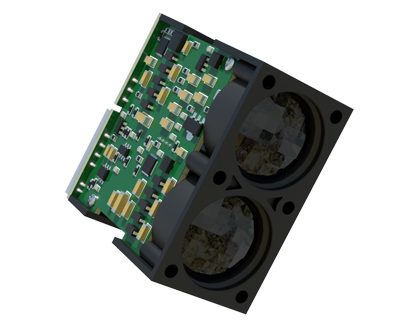
The architecture of a modern laser vision welding system is robust. The sensor head, often integrated directly into the welding torch or mounted adjacent to it, is engineered to withstand extreme conditions: intense arc radiation, spatter, high temperatures, and mechanical shock. Advanced optical filters and specialized camera sensors are employed to suppress the blinding light from the welding arc, allowing the laser line to be clearly visible for tracking even during the welding process itself (real-time tracking). This enables closed-loop correction throughout the entire weld cycle. Communication is typically handled via industrial Ethernet protocols (e.g., EtherCAT, PROFINET), ensuring high-speed, deterministic data transfer between the sensor, robot controller, and welding power source.
Key application areas highlight its versatility. In the automotive industry, laser vision sensors are indispensable for body-in-white assembly, ensuring perfect seams for structural integrity and crash performance. In heavy machinery and construction equipment manufacturing, they handle the large tolerances inherent in massive fabrications. For precision industries like aerospace or medical device manufacturing, they provide the micron-level accuracy required for critical welds on thin materials or complex geometries. The technology is equally effective across welding processes, including Gas Metal Arc Welding (GMAW/MIG), Gas Tungsten Arc Welding (GTAW/TIG), and laser welding itself, where precise beam-to-joint alignment is paramount.
Implementing such a system requires careful consideration. Sensor selection depends on required resolution, working distance, and the specific joint types (butt, lap, fillet, V-groove). System integration involves meticulous calibration to align the sensor's coordinate system with the robot's and the welding torch's Tool Center Point (TCP). Programming must define search routines to initially locate the joint and establish the tracking parameters. While the initial investment is significant, the Return on Investment (ROI) is compelling, driven by dramatic reductions in post-weld inspection, elimination of fixture costs for precise part holding, increased equipment uptime, and most importantly, a near-zero defect rate. As Industry 4.0 advances, these sensors are becoming data nodes, feeding weld quality and dimensional data into Manufacturing Execution Systems (MES) for traceability and predictive analytics, pushing automated welding from mere repetition towards true cognitive manufacturing.