Inductive proximity sensors are fundamental components in modern industrial automation, offering non-contact detection of metallic objects. Their reliability, durability, and speed make them indispensable in manufacturing, packaging, robotics, and countless other sectors. This article delves into the operating principles, key characteristics, common applications, and critical factors for selecting the right sensor for your needs.
At the heart of an inductive proximity sensor lies a simple yet effective principle: electromagnetic induction. The sensor's active face contains a coil that is part of an oscillator circuit, generating a high-frequency electromagnetic field. When a metallic object (the target) enters this field, eddy currents are induced on the surface of the target. These eddy currents draw energy from the oscillator, causing a reduction in its amplitude. An evaluation circuit within the sensor monitors this amplitude change. Once the amplitude drop reaches a predetermined threshold, the sensor's output state switches, signaling the presence of the target. When the target moves away, the oscillator's amplitude recovers, and the output returns to its original state.
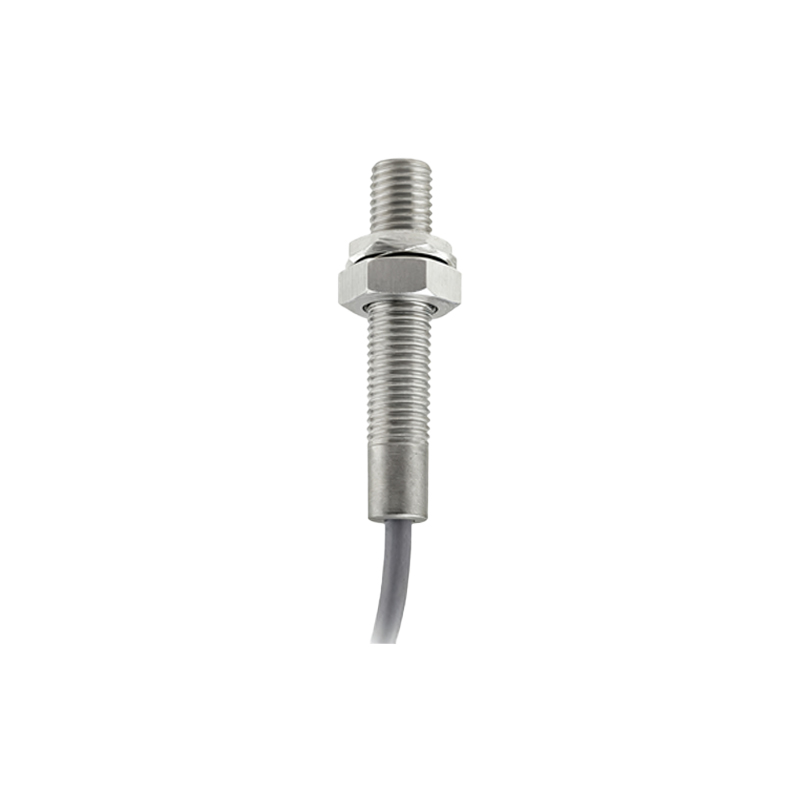
Key specifications define the performance and suitability of an inductive sensor. The sensing distance, or nominal range, is a crucial parameter, typically ranging from 1 to 60 mm for standard models. It's important to note that this distance is defined for a standard target of mild steel. Different metals affect the sensing range due to their varying electrical conductivity and magnetic permeability. A reduction factor is often provided, indicating that for metals like aluminum or copper, the effective sensing distance is less than the nominal rating. The switching frequency indicates how many detection cycles per second the sensor can handle, critical for high-speed applications. Hysteresis is the difference between the switch-on and switch-off points, which prevents output chatter when a target is at the exact sensing edge. Most industrial sensors feature built-in protection against short-circuit, overload, and reverse polarity, enhancing their ruggedness. Common output configurations include PNP (sourcing), NPN (sinking), Normally Open (NO), and Normally Closed (NC), with 2-wire and 3-wire DC versions being prevalent, alongside 4-wire versions offering both NO and NC signals.
The applications for inductive proximity switches are vast. They are extensively used for position sensing—verifying if a cylinder is extended or retracted, or if a part is in place for the next machining operation. End-of-travel detection on linear actuators and conveyors is another common use. In high-speed counting tasks, such as monitoring bottles on a line or parts on an indexing table, their fast response is essential. They provide jam detection in material handling systems and speed monitoring by detecting gear teeth or holes on a rotating disc. Their non-contact nature makes them ideal for wear-free limit switching, eliminating mechanical failure points associated with traditional lever-arm switches.
Selecting the appropriate inductive sensor requires careful consideration of several factors. First, identify the target material (ferrous like steel, or non-ferrous like aluminum, brass, stainless steel) and its size, as this directly impacts the effective sensing range. The required sensing distance should have a safety margin; do not operate the sensor at its absolute maximum nominal range. The installation environment is critical: consider temperature extremes, potential for washdown (requiring high IP ratings like IP67 or IP69K), exposure to cutting fluids or welding spatter, and strong external magnetic fields. The electrical requirements must match the control system: DC voltage (typically 10-30V DC), current draw, and the required output type (PNP/NPN). For tight spaces, form factor (barrel-style, rectangular, or ring-shaped) and mounting style (flush or non-flush) are important. Flush-mounted sensors can be embedded in metal without affecting performance, whereas non-flush types offer longer ranges but require a metal-free zone around them.
In conclusion, inductive proximity sensors are robust, versatile workhorses of industrial sensing. By understanding their operating principle and carefully matching their specifications—sensing distance, target material, environmental ratings, and electrical interface—to the application demands, engineers can ensure reliable, maintenance-free operation for years. Their continued evolution, including miniaturization, increased sensing ranges, and enhanced connectivity via IO-Link, ensures they will remain a cornerstone of automated system design, providing the essential "eyes" for machinery to interact with the physical world.