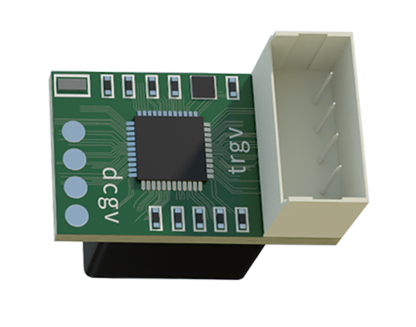
In the realm of industrial automation and precision measurement, laser distance sensors have become indispensable tools. Their ability to provide non-contact, high-accuracy measurements across various ranges and materials is well-documented. However, a critical yet sometimes overlooked aspect of their selection and application is their physical dimensions. The size and form factor of a laser distance sensor are not merely aesthetic considerations; they are fundamental to its functionality, integration feasibility, and long-term reliability in diverse operational environments.
The dimensions of a laser distance sensor typically encompass its length, width, height (or diameter for cylindrical models), and weight. These parameters are intrinsically linked to the sensor's internal components, which include the laser diode, optics (lenses), photodetector, processing electronics, and housing. A sensor designed for long-range measurement, for instance, often requires a larger aperture and more sophisticated optics, potentially leading to a larger housing. Conversely, miniaturized sensors, which are increasingly popular for robotics and compact machinery, achieve their small size through advanced integrated circuits and micro-optics, sometimes trading off maximum range or certain environmental protections.
Understanding the dimensional specifications is paramount for mechanical integration. Engineers must consider the available space within the machine or on the production line. A sensor that is too large may simply not fit into the designated mounting location. More subtly, its size can affect the mounting options. Common housing shapes include rectangular blocks, cylindrical barrels, and compact cube-style designs. Cylindrical sensors, for example, are often easier to mount using standard brackets or clamping rings and may offer better sealing for harsh environments. The location and type of connection ports (e.g., M8, M12 connectors) also contribute to the effective "envelope" of the sensor and must be accounted for to ensure proper cable routing without strain.
Beyond simple fit, dimensions influence performance. The baseline distance, or the physical offset from the sensor's mounting point to its measurement reference point, is a direct function of its housing design. Accurate CAD integration requires precise knowledge of this offset to program measurement coordinates correctly. Furthermore, the size of the exit aperture affects the beam's characteristics. A smaller aperture might produce a more focused beam spot at a specific distance, which is advantageous for targeting small objects, but it could also be more susceptible to contamination. The sensor's mass and center of gravity are also vital for dynamic applications, such as on moving robotic arms, where excessive weight or poor balance can affect arm speed, accuracy, and wear.

Environmental ratings, such as IP67 or IP69K for dust and water resistance, also correlate with dimensions. Achieving a high ingress protection rating often requires robust housing with specific seals, which can add to the overall size and weight. A sensor destined for washdown environments in food and beverage processing will have different dimensional and sealing considerations compared to a lightweight sensor for clean-room electronics assembly.
When selecting a laser distance sensor, a holistic view that balances dimensional constraints with performance requirements is essential. The key is to consult the detailed mechanical drawings provided in the sensor's datasheet. These drawings provide not just outer dimensions but also critical details like mounting hole patterns, thread sizes, and connector positions. Ignoring these details can lead to costly redesigns, installation delays, or suboptimal sensor performance. In summary, the dimensions of a laser distance sensor are a fundamental specification that bridges the gap between its theoretical measurement capabilities and its practical, successful implementation in the real-world industrial landscape. A careful evaluation ensures seamless integration, reliable operation, and ultimately, a return on investment through enhanced process accuracy and efficiency.