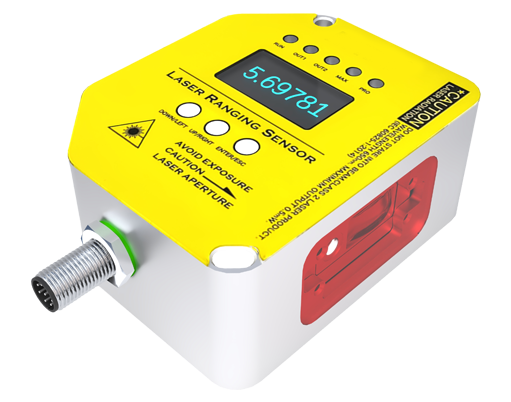
In the realm of industrial automation and precision measurement, laser positioning sensors have become indispensable tools. Their ability to provide non-contact, high-accuracy distance and position measurements is critical for applications ranging from robotics and manufacturing to quality control and logistics. A fundamental yet often overlooked aspect of these sensors is the wavelength of the laser light they emit. This parameter is not merely a technical specification; it is a core determinant of a sensor's performance, suitability for specific tasks, and interaction with the target material and environment.
Laser positioning sensors typically operate within specific wavelength bands in the electromagnetic spectrum. The most common wavelengths used are in the visible red spectrum (around 650-670 nm), the near-infrared (NIR) spectrum (around 780-1550 nm), and, for specialized applications, blue or violet lasers (around 405-450 nm). Each of these wavelength ranges offers distinct advantages and presents unique challenges.
The classic red laser diode, operating around 650-670 nm, is widely used due to its cost-effectiveness and visibility. The visible beam allows for easy alignment and setup, which is a significant practical advantage during installation and troubleshooting. However, this visibility can also be a drawback in environments where the laser spot might be distracting or interfere with other optical systems. Furthermore, red lasers can be more susceptible to interference from ambient light, particularly from incandescent or halogen sources, requiring robust filtering electronics. Their performance on certain materials, especially red or warm-colored surfaces, may also be less optimal due to lower contrast in reflectivity.
Near-infrared lasers, particularly those around 780-850 nm and 1300-1550 nm, are the workhorses for many demanding industrial applications. Their primary advantage lies in their relative invisibility to the human eye, making them suitable for environments where a visible beam is undesirable. More importantly, NIR wavelengths often exhibit better performance on a wider variety of materials. Many organic materials, plastics, and dark surfaces have different absorption and reflection characteristics in the NIR range compared to visible red light, potentially offering higher signal strength and stability. Sensors using 1300-1550 nm wavelengths benefit from being in the "eye-safe" region (Class 1 laser safety under certain conditions), as the cornea and lens of the eye do not focus this light onto the retina, allowing for higher permissible exposure limits and enabling more powerful, longer-range sensors without stringent safety enclosures.

Emerging technologies utilize blue and violet laser diodes. The shorter wavelength (higher frequency) of blue light, typically around 405-450 nm, provides a smaller, more focused spot size for a given optical system. This enables higher lateral resolution, which is crucial for applications involving very small features or requiring extreme edge detection precision. Blue lasers also interact differently with materials; they are often absorbed more by certain substances (like some plastics or coatings) and reflected more specularly by others (like metals), which can be leveraged for specific measurement tasks where red or NIR lasers perform poorly. However, blue laser diodes have historically been more expensive and can have different longevity characteristics compared to well-established red and NIR diodes.
Selecting the appropriate wavelength is a critical engineering decision. It involves a careful analysis of the target material's optical properties. A material that appears dark to the human eye may be highly reflective in the NIR spectrum. The environmental conditions are equally important. Sensors operating in environments with high levels of ambient infrared radiation (e.g., near furnaces or hot objects) might benefit from a wavelength band that avoids these spectral interferences. Safety regulations (IEC 60825) also dictate the classification of the laser product, influencing enclosure requirements and operational procedures, with longer NIR wavelengths often providing more flexibility.

Furthermore, the choice of wavelength is intrinsically linked to the sensor's detection technology—whether it uses triangulation, time-of-flight, or confocal principles. The optical components, such as lenses and filters, are optimized for specific wavelengths. A filter designed to block ambient light at 670 nm will be ineffective for a 1550 nm laser. Therefore, the entire optical path must be engineered as a coherent system centered on the chosen laser wavelength.
In conclusion, the wavelength of a laser positioning sensor is a pivotal specification that directly influences measurement accuracy, material compatibility, environmental robustness, and operational safety. It is not a one-size-fits-all parameter. Engineers and system integrators must move beyond simply considering range and resolution. A deep understanding of the application's specific requirements—the target material's reflectivity spectrum, the ambient light conditions, safety constraints, and the required spot size—is essential for selecting the optimal laser wavelength. This informed selection ensures reliable sensor performance, maximizes process efficiency, and guarantees a successful integration into any precision measurement or automation system. As laser technology continues to evolve, with new wavelengths and more powerful diodes becoming available, this fundamental understanding will remain the key to unlocking their full potential.