In the realm of precision measurement and industrial automation, laser linear displacement sensors have emerged as a cornerstone technology. These sophisticated devices provide non-contact, high-accuracy measurements of position, distance, and displacement, making them indispensable in applications ranging from quality control to robotics. Unlike traditional contact-based sensors or other non-contact methods like ultrasonic or inductive sensors, laser sensors utilize the principle of optical triangulation or time-of-flight to achieve micron-level precision.
At the heart of a laser linear displacement sensor is a focused laser diode that projects a small, coherent light spot onto the target surface. The reflected light is then captured by a receiving element, typically a position-sensitive detector (PSD) or a charge-coupled device (CCD). In the common triangulation method, the displacement of the reflected light spot on the detector is geometrically calculated to determine the exact distance to the target. This method offers exceptional resolution and high-frequency response. For longer ranges, time-of-flight sensors measure the phase shift or the direct time delay of a modulated laser beam, providing robust measurements over several meters.
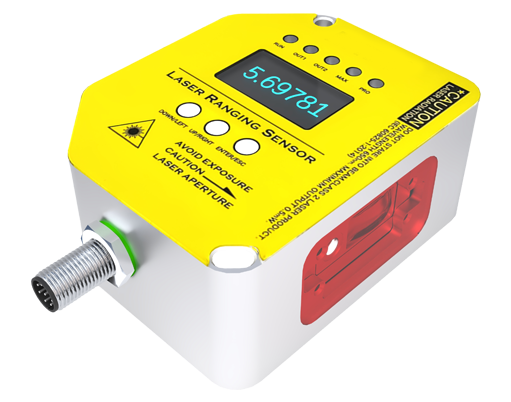
The advantages of using laser-based sensors are manifold. Their non-contact nature eliminates mechanical wear and prevents damage to both the sensor and the target object, which is crucial for measuring delicate or moving surfaces. They offer extremely high resolution, often down to sub-micron levels, and boast very fast response times, enabling real-time monitoring in dynamic processes. Furthermore, they are largely unaffected by the material properties of the target, such as color or reflectivity, especially models with advanced algorithms for surface compensation, though highly specular or transparent surfaces can pose challenges.

Industrial applications are vast and varied. In manufacturing, they are used for precise thickness gauging of materials like metal sheets, films, and glass. In automotive assembly, they ensure the exact positioning of components. They play a critical role in the electronics industry for inspecting circuit board flatness and component placement. Robotics relies on them for accurate guidance and obstacle detection. Additionally, they are employed in research and development for vibration analysis, deformation testing, and prototype validation.
Selecting the right laser linear displacement sensor requires careful consideration of several key parameters. The measuring range defines the minimum and maximum distances the sensor can handle. Resolution indicates the smallest detectable change in distance. Linearity error specifies the deviation from a perfect straight-line response over the measuring range. The spot size of the laser is important for measuring small features or uneven surfaces. Environmental factors such as ambient light, temperature fluctuations, and exposure to dust or vapors must also be accounted for, often necessitating sensors with appropriate ingress protection (IP) ratings and temperature compensation.
Installation and alignment are critical for optimal performance. The sensor must be mounted stably to minimize vibration, and the laser beam should be perpendicular to the target surface within the specified tolerance to avoid cosine errors. Regular calibration against a known standard is recommended to maintain long-term accuracy. Modern sensors often come with intuitive software interfaces for configuration, data logging, and integration into larger control systems via analog outputs or digital protocols like Ethernet/IP or PROFINET.

In conclusion, laser linear displacement sensors represent a powerful solution for demanding measurement tasks. Their precision, speed, and versatility make them a preferred choice in modern industry. By understanding their operating principles, key specifications, and application requirements, engineers and technicians can effectively leverage this technology to enhance process control, improve product quality, and drive innovation. As technology advances, we can expect these sensors to become even more compact, intelligent, and integrated into the Industrial Internet of Things (IIoT) ecosystem.