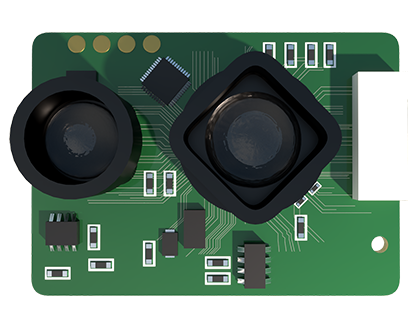
In the realm of industrial automation and precision measurement, the infrared laser linear sensor stands as a pivotal technology, enabling non-contact, high-accuracy detection and positioning. Unlike conventional sensors, these devices utilize a focused beam of infrared laser light to detect objects, measure distances, or ascertain alignment with exceptional precision. The core principle involves emitting a modulated infrared laser beam towards a target. The sensor then analyzes the reflected light—its intensity, time-of-flight, or triangulation angle—to calculate precise linear position, displacement, or simply the presence/absence of an object. This method offers significant advantages over mechanical contact probes or standard photoelectric sensors, including minimal wear, immunity to ambient visible light interference, and the ability to measure shiny, dark, or transparent objects that often challenge other optical methods.
The architecture of a typical infrared laser linear sensor comprises several key components. A laser diode generates a coherent, collimated beam in the infrared spectrum, usually at wavelengths such as 850nm or 905nm, which is invisible to the human eye for safety and reduced distraction. This beam passes through a lensing system to focus it into a precise spot. A high-sensitivity photodetector, often a position-sensitive device (PSD) or a CMOS/CCD array, captures the reflected light. Sophisticated onboard electronics process the signal, applying algorithms for background light suppression, signal amplification, and computation to output a stable analog signal (e.g., 4-20mA, 0-10V) or a digital signal via interfaces like IO-Link, RS-485, or Ethernet/IP. The housing is typically ruggedized to IP67 or higher standards, ensuring reliable operation in harsh industrial environments with dust, moisture, and vibration.

Applications for infrared laser linear sensors are vast and critical across numerous sectors. In automotive manufacturing, they are deployed for robotic guidance, gap and flush measurement on vehicle panels, and precise parts positioning. Within the electronics industry, they ensure the accurate placement of components on printed circuit boards (PCBs) and measure wafer thickness or warpage. Packaging and material handling lines rely on them for edge detection, web tension control, and fill-level monitoring. Furthermore, in logistics, they facilitate dimensioning systems for parcels. Their non-contact nature makes them ideal for measuring delicate or hot surfaces, such as in glass production or metal forging, where physical contact is impossible or detrimental.
Selecting the appropriate infrared laser linear sensor requires careful consideration of several technical parameters. The measuring range defines the minimum and maximum distances over which the sensor can operate accurately. Resolution, often in micrometers, indicates the smallest detectable change in position. Repeatability specifies the sensor's consistency in returning the same measurement under identical conditions. The spot size is crucial; a smaller spot allows for higher resolution on small features but may require more precise alignment. Response time must match the speed of the application. Environmental factors like ambient temperature range, potential exposure to contaminants, and the material/color of the target object also heavily influence the choice. For instance, a red laser might be chosen for visible alignment during setup, but an infrared laser is superior for long-term stability and reduced ambient light interference.
Integration and calibration are vital steps for optimal performance. Proper mechanical mounting, ensuring stability and correct alignment relative to the target path, is fundamental. Electrical integration involves connecting power and output signals to the control system, such as a PLC. Many modern sensors feature teach-in functions or software suites for easy configuration of measuring windows, output scaling, and filtering parameters. Regular maintenance, primarily keeping the lens clean from dust and oil buildup, is simple but essential to maintain specified accuracy. It is also critical to adhere to laser safety classifications (typically Class 1 or Class 2 for these sensors), ensuring safe operation without requiring elaborate protective measures in industrial settings.

Looking ahead, the evolution of infrared laser linear sensors is intertwined with Industry 4.0 trends. Enhanced connectivity through industrial IoT protocols allows for predictive maintenance, remote monitoring, and data integration into digital twin models. Advances in chip technology are leading to sensors with even higher resolutions, faster response times, and more compact form factors. Furthermore, the integration of additional sensing modalities, such as combined distance and profile measurement, is expanding their capabilities. As demand for precision, flexibility, and intelligence in automation grows, the infrared laser linear sensor will continue to be an indispensable tool, driving efficiency and quality in modern manufacturing and beyond. Engineers must stay informed on these developments to leverage the full potential of this versatile sensing technology.