In industrial automation and control systems, proximity sensors play a critical role in detecting the presence or absence of objects without physical contact. Among the various configurations, the Normally Closed (NC) proximity sensor is a fundamental component with distinct operational characteristics and application advantages. This article delves into the working principle, wiring, application scenarios, and selection criteria for NC proximity sensors, providing essential insights for electrical engineers and system designers.
A Normally Closed proximity sensor, in its default state without a target present, maintains a closed electrical circuit. This means the output signal circuit is complete, allowing current to flow. When a target object enters the sensor's detection range, it triggers the sensor, causing the internal switching element to open the circuit and interrupt the current flow. This behavior is the inverse of a Normally Open (NO) sensor. The NC configuration is inherently tied to the concept of "fail-safe" design. In many safety-critical or monitoring applications, an unexpected break in the wiring or a loss of power to the sensor itself will cause the circuit to open. Since an NC sensor's normal state is "closed," this fault condition mimics the "target present" state, often triggering an alarm or putting a machine into a safe state. This makes NC sensors highly valuable for applications where safety is paramount, such as in guard door monitoring, emergency stop circuits, or critical position verification.
The working principle depends on the underlying technology. Inductive NC sensors detect metallic objects. They contain an oscillator circuit that generates an electromagnetic field. When a metal target enters this field, it induces eddy currents, which dampen the oscillator's amplitude. This change is detected by a threshold circuit, which triggers the solid-state or reed switch to change state—opening the closed circuit. Capacitive NC sensors can detect both metallic and non-metallic materials by sensing changes in capacitance caused by the target altering the electrostatic field. Ultrasonic and photoelectric sensors also come in NC variants, where the interruption of a sound wave or light beam opens the pre-closed output circuit.
Wiring an NC sensor typically involves three wires: brown for DC positive (or L+), blue for DC common (or L- or N), and black for the switched output signal. In a standard 3-wire DC sinking (NPN) configuration, the black wire is connected to the load, which is then connected to the positive supply. When the sensor is inactive (no target), the internal switch connects the black wire to the blue wire (common), completing the circuit to the load. Upon detection, this connection opens, turning the load off. For sourcing (PNP) configurations, the logic is reversed but the NC concept remains: the output provides positive voltage in the idle state and switches off when activated. It is crucial to consult the specific datasheet, as wire colors can vary by manufacturer and region.
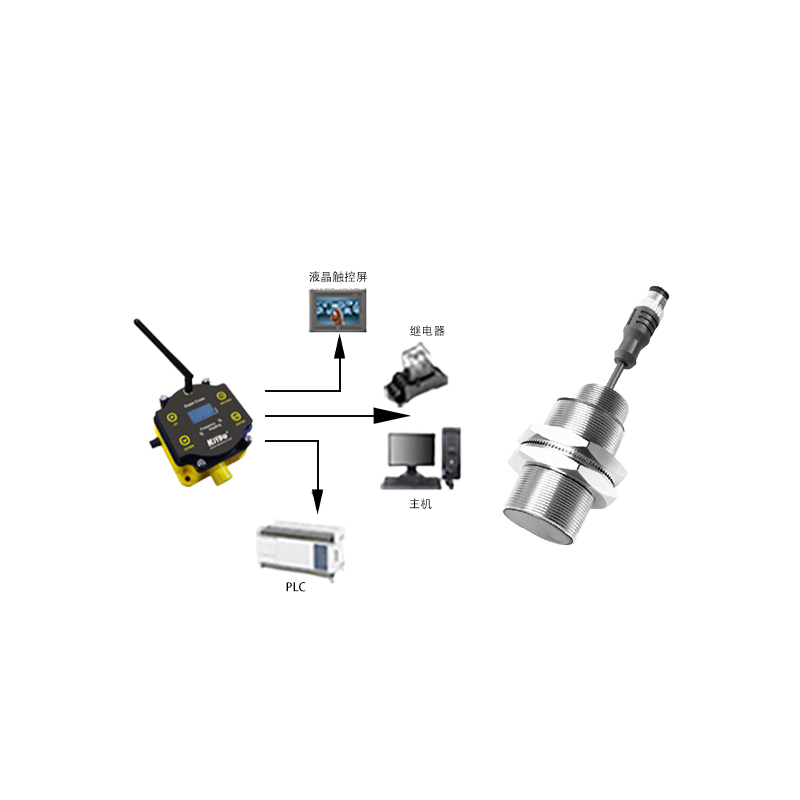
The selection of an NC sensor over an NO sensor is primarily driven by safety logic and circuit design requirements. Key application areas include:
1. Safety Interlocks: On machine guard doors, an NC sensor ensures that if the door is opened or the sensor wire is cut, the control system interprets it as an unsafe condition, immediately halting the machine.
2. Emergency Stop Monitoring: Circuits designed with NC contacts ensure that any break in the E-stop loop de-energizes the controlling relay.
3. Fault Detection: Used to monitor the presence of a safety shield or cover. Its absence (or a wiring fault) is detected as a constant "target present" signal.
4. Redundancy in High-Reliability Systems: Often used in tandem with NO sensors in complementary pairs to create checking mechanisms that can identify sensor failures.
When selecting an NC proximity sensor, engineers must consider several parameters beyond the switching logic:
Sensing Technology: Choose inductive, capacitive, photoelectric, or ultrasonic based on the target material and environmental conditions (dust, moisture, etc.).
Detection Range: Ensure the specified range accommodates the application with a suitable safety margin.
Output Type: Solid-state (PNP/NPN) or relay contact, compatible with the PLC or controller input module.
Electrical Ratings: Voltage and current ratings must match the control circuit requirements without exceeding limits.
Environmental Protection: Ingress Protection (IP) rating (e.g., IP67) for resistance to dust and water, and temperature range for the operating environment.
Mounting Style: Barrel-shaped, rectangular, or ring-style to fit the mechanical design.
In conclusion, the Normally Closed proximity sensor is a vital tool in an engineer's arsenal, offering a reliable fail-safe characteristic that enhances system safety and reliability. Its correct implementation requires a clear understanding of its operational logic—closing the circuit for "no target" and opening it for "target present