In the rapidly evolving landscape of industrial automation, circular laser sensors have emerged as a pivotal technology, offering unparalleled precision and versatility. Unlike traditional point or line laser sensors, these devices emit a 360-degree circular laser beam, enabling comprehensive detection and measurement in complex environments. The core principle involves projecting a concentric ring of laser light onto a target surface. Any disruption or reflection of this ring is captured by a high-resolution receiver, allowing for precise calculation of distance, presence, or profile characteristics. This omnidirectional scanning capability is particularly transformative for applications involving cylindrical objects, robotic guidance, and contour inspection, where complete peripheral data is crucial.
The operational advantages of circular laser sensors are manifold. Their primary strength lies in eliminating blind spots. In assembly line quality control, for instance, a single circular sensor can inspect the entire circumference of a bottle for defects, cracks, or fill-level inconsistencies, a task that would require multiple linear sensors or complex mechanical rotation. This not only streamlines the inspection process but also significantly reduces system cost and footprint. Furthermore, these sensors exhibit exceptional performance in challenging conditions. Advanced models are equipped with algorithms to filter out ambient light interference and are built with robust housings rated for IP67 or higher, ensuring reliable operation in dusty, humid, or vibratory industrial settings. The non-contact nature of the measurement also prevents part wear or damage, maintaining product integrity.
A key application driving adoption is in robotics and autonomous guided vehicles (AGVs). Circular laser sensors mounted on robotic arms provide real-time, full-perimeter data for precise object grasping, alignment, and placement, especially for irregularly shaped components. In logistics, AGVs utilize these sensors for accurate pallet detection and fork alignment, enhancing warehouse automation efficiency. Another critical use case is in dimensional metrology. Manufacturers of shafts, pipes, and bearings employ circular laser sensors for high-speed diameter verification and ovality measurement, ensuring tight tolerances are maintained throughout production.
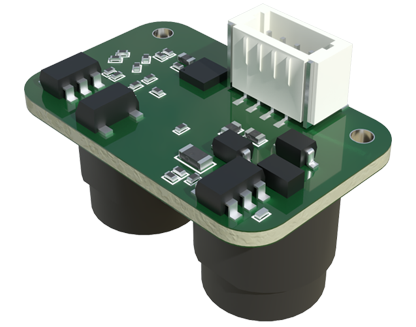
The integration of circular laser sensors with Industry 4.0 frameworks is amplifying their impact. Modern sensors come with industrial communication protocols like IO-Link, EtherNet/IP, and PROFINET, facilitating seamless data exchange with PLCs and SCADA systems. This connectivity enables predictive maintenance, where sensor performance data can be analyzed to anticipate calibration needs or potential failures, minimizing downtime. The data richness provided by a circular scan—essentially a dense point cloud—also feeds into digital twin models, creating a virtual replica of the physical process for simulation and optimization.
Looking ahead, advancements in laser diode technology and computational power are set to enhance the capabilities of circular laser sensors further. We anticipate developments in higher scanning frequencies for ultra-high-speed production lines, improved resolution for micron-level accuracy, and smarter embedded edge-processing to deliver actionable insights directly from the sensor. As industries strive for greater efficiency, flexibility, and quality, the circular laser sensor stands as a critical enabler, transforming how machines perceive and interact with their environment in the automated factory of the future.