In modern industrial automation, laser sensors have become indispensable components for precision measurement, object detection, and quality control. The design of these sensors involves a multidisciplinary approach, combining optics, electronics, and software engineering to achieve high accuracy, reliability, and adaptability in harsh environments. This article delves into the core principles of laser sensor design, focusing on key considerations for engineers developing solutions for industrial applications.
The foundation of any laser sensor lies in its optical system. The selection of the laser source is critical, with common choices including laser diodes, vertical-cavity surface-emitting lasers (VCSELs), and fiber lasers. Each type offers distinct advantages in terms of wavelength, coherence, power output, and cost. For instance, laser diodes in the visible or near-infrared spectrum are favored for their compact size and efficiency in proximity sensing, while VCSELs provide superior beam quality for 3D imaging. The optical design must also incorporate lenses and apertures to shape and focus the laser beam, ensuring minimal divergence and optimal spot size on the target. Beam shaping techniques, such as using aspheric lenses or diffractive optical elements, can enhance measurement resolution and reduce optical noise.
Beyond the light source, the detection mechanism is equally vital. Photodiodes, including PIN photodiodes and avalanche photodiodes (APDs), are commonly employed to convert reflected light into electrical signals. The choice depends on required sensitivity and response speed; APDs, with their internal gain, are suitable for low-light conditions but require careful bias voltage control. Signal conditioning circuits, comprising transimpedance amplifiers and filters, are then used to process these weak signals, amplifying them while minimizing noise from ambient light or electrical interference. Advanced designs integrate analog-to-digital converters (ADCs) early in the chain to facilitate digital signal processing (DSP), enabling real-time analysis of signal characteristics like time-of-flight (ToF) or phase shift for distance measurement.
Environmental robustness is a non-negotiable aspect of industrial laser sensor design. Sensors must operate reliably under extreme temperatures, vibration, dust, and moisture. This necessitates protective housings rated to IP67 or higher, along with temperature compensation algorithms to maintain calibration. For example, in automotive assembly lines, laser sensors used for weld inspection are encased in ruggedized metal bodies with sealed optical windows to withstand spatter and coolant exposure. Additionally, thermal management through heat sinks or Peltier coolers prevents laser wavelength drift, which could compromise accuracy.
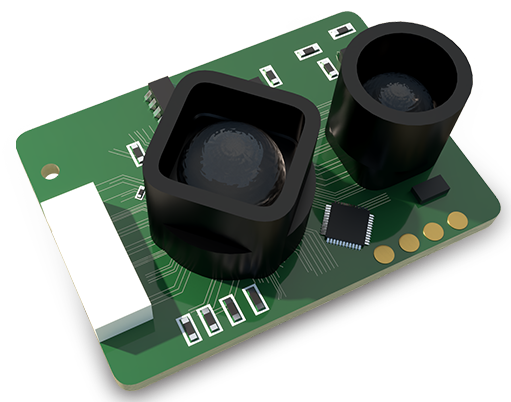
Software and firmware integration play a pivotal role in enhancing functionality. Modern laser sensors often embed microcontrollers or FPGAs to execute complex algorithms for edge computing. Features like background suppression, teach-in programming, and multi-echo evaluation allow sensors to adapt to varying target surfaces and distances. Communication interfaces—such as IO-Link, Ethernet/IP, or PROFINET—enable seamless integration into industrial networks, providing diagnostic data and remote configuration capabilities. Machine learning techniques are increasingly being incorporated to differentiate between objects or detect anomalies based on pattern recognition in the reflected signal.

In application-specific designs, engineers must balance performance parameters like range, resolution, and response time. For high-speed sorting on conveyor belts, sensors with submicrosecond response times and narrow beam angles are essential to detect small items without false triggers. Conversely, in warehouse automation for pallet detection, longer-range sensors with wider fields of view prioritize coverage over fine detail. Power consumption is another consideration, especially for battery-operated or distributed sensor networks, where low-power modes and efficient drive circuits extend operational life.
Future trends in laser sensor design point toward miniaturization and multifunctionality. Emerging technologies like silicon photonics allow integration of optical components on chips, reducing size and cost while improving reliability. Additionally, the adoption of multispectral laser systems enables material analysis alongside dimensional measurement, opening new avenues for quality assurance. As Industry 4.0 advances, laser sensors will evolve into smarter, interconnected nodes within the Industrial Internet of Things (IIoT), driving efficiency and innovation across manufacturing, logistics, and beyond. By adhering to these design principles—meticulous optical engineering, robust construction, and intelligent software—engineers can develop laser sensors that meet the ever-growing demands of modern industry.