In the realm of industrial automation and precision measurement, laser sensors have become indispensable tools, and among the leading technologies, SOMET laser sensors stand out for their reliability and advanced capabilities. This article provides a comprehensive technical overview of SOMET laser sensors, detailing their operating principles, key features, and diverse applications across various industries.
SOMET laser sensors operate primarily on the principle of triangulation or time-of-flight (ToF), depending on the specific model and application requirements. Triangulation-based sensors emit a laser beam onto a target surface; the reflected light is then captured by a receiver at a known angle. By calculating the displacement of the light spot on the receiver, the sensor accurately determines the distance to the target. This method offers high precision for short to medium ranges, making it ideal for tasks such as thickness measurement, edge detection, and profile scanning. In contrast, ToF-based sensors measure the time it takes for a laser pulse to travel to the target and back, enabling distance calculation over longer ranges with robust performance in challenging environments like outdoor settings or large-scale logistics.

The core advantages of SOMET laser sensors lie in their exceptional accuracy, high resolution, and fast response times. Typical models boast measurement resolutions down to the micrometer level, with response frequencies exceeding several kilohertz, allowing for real-time monitoring in dynamic production lines. Furthermore, these sensors are engineered with robust housings, often rated IP67 or higher, ensuring resistance to dust, moisture, and mechanical vibrations. This durability is crucial in harsh industrial settings such as automotive manufacturing, metal processing, and pharmaceutical packaging. Many SOMET sensors also incorporate intelligent features like automatic calibration, temperature compensation, and programmable logic outputs, which simplify integration into complex control systems and reduce maintenance overhead.
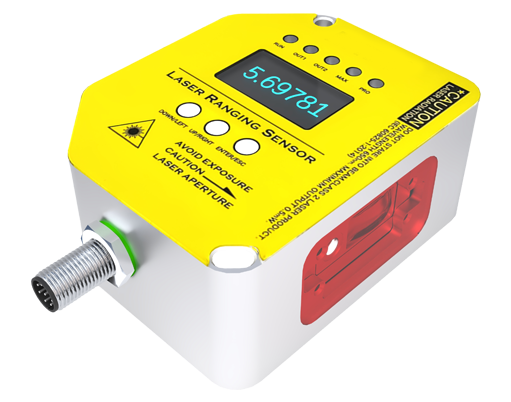
Applications of SOMET laser sensors span a wide spectrum. In automotive assembly, they are used for precise gap and flush measurement between body panels, ensuring quality and consistency. In the electronics industry, these sensors facilitate the inspection of component placement on printed circuit boards (PCBs) and the measurement of solder paste thickness. Logistics and warehousing benefit from their ability to detect object presence, measure parcel dimensions, and guide automated guided vehicles (AGVs). Additionally, in renewable energy sectors, such as solar panel manufacturing, SOMET sensors assist in aligning silicon wafers and monitoring coating uniformity.
When selecting a SOMET laser sensor, engineers must consider several parameters: measurement range, spot size, linearity error, and environmental conditions. For instance, a smaller laser spot enables higher resolution for detailed surface analysis, while a larger spot may be preferable for detecting uneven or diffuse surfaces. Connectivity options, including analog outputs (e.g., 4-20 mA, 0-10 V), digital interfaces (e.g., IO-Link, Ethernet/IP), and serial communication protocols, should align with the existing plant infrastructure. Proper installation is also critical; factors like mounting stability, avoidance of ambient light interference, and regular lens cleaning can significantly impact sensor performance and longevity.
Looking ahead, advancements in SOMET laser sensor technology are focusing on enhanced miniaturization, increased integration with Industrial Internet of Things (IIoT) platforms, and improved algorithms for data analytics. These developments promise even greater efficiency, predictive maintenance capabilities, and adaptability in smart factories. In summary, SOMET laser sensors represent a pivotal component in modern industrial systems, offering precision, durability, and versatility that drive productivity and quality assurance across global markets.