In the realm of precise distance measurement, short-range laser rangefinder sensors have emerged as indispensable tools across a diverse spectrum of industries. Unlike their long-range counterparts designed for surveying or military use, these compact devices excel at accurately determining distances from a few centimeters up to several hundred meters. Their operation is elegantly based on the time-of-flight (ToF) principle. The sensor emits a focused pulse of laser light towards a target. A high-speed photodetector then captures the reflection. By calculating the incredibly brief time interval between the emission and the return of the pulse, and knowing the constant speed of light, the sensor's internal processor computes the exact distance with remarkable accuracy.
The core advantages of these sensors are what drive their widespread adoption. Foremost is their exceptional precision, often achieving sub-millimeter accuracy at close ranges. This is coupled with high-speed measurement capabilities, allowing for thousands of distance readings per second, which is crucial for dynamic applications. Furthermore, laser rangefinders are non-contact measurement devices. This means they can assess the distance to fragile, hot, moving, or otherwise inaccessible objects without any physical interaction, preventing damage or interference. Their compact size, low power consumption, and increasing affordability have made them accessible for integration into both industrial systems and consumer products.
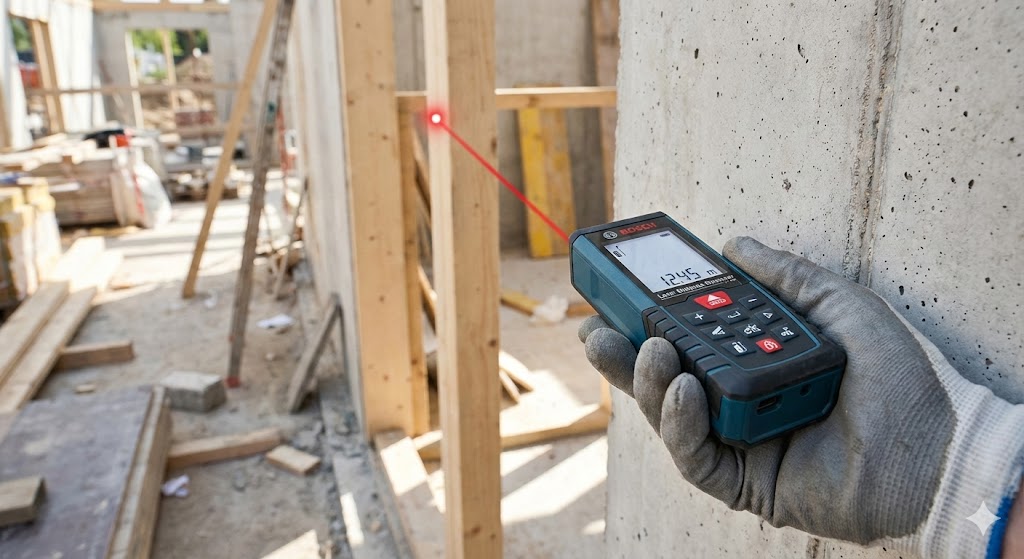
The applications for short-range laser rangefinders are vast and continually expanding. In industrial automation and robotics, they are pivotal for object detection, positioning, and collision avoidance. Robotic arms use them for precise pick-and-place operations, while automated guided vehicles (AGVs) rely on them for navigation and pallet docking. Within the construction and interior design sectors, these sensors are the technology behind modern laser tape measures, enabling quick and accurate room dimensioning, area calculation, and leveling tasks.
The consumer electronics market has also been transformed by miniaturized versions of this technology. Smartphones incorporate tiny laser autofocus sensors to achieve faster and more accurate focus locking, especially in low-light conditions. In the realm of virtual and augmented reality (VR/AR), laser sensors help in spatial mapping and hand-tracking, creating more immersive and interactive experiences. Even hobbyists and makers utilize compact laser rangefinder modules for projects involving drones, 3D scanning, and custom automation.
When selecting a short-range laser rangefinder sensor, several key specifications must be considered. The measurement range defines its minimum and maximum operational distance. The accuracy and resolution specify the reliability and fineness of the measurements. The measurement rate or frequency determines how quickly it can update the distance value, which is vital for tracking moving objects. Other factors include the laser class (with Class 1 or 2 being common for eye-safe operation), the interface (such as UART, I2C, or analog voltage), and environmental robustness features like ingress protection (IP) ratings for dust and water resistance.
Looking ahead, the evolution of short-range laser rangefinding technology points toward even greater miniaturization, reduced power demands, and enhanced functionality. The integration of multi-sensor packages, combining laser data with inertial measurement units (IMUs) or cameras for sensor fusion, is creating smarter perception systems. Furthermore, the development of solid-state laser beam steering, eliminating moving parts, promises more reliable and compact designs for the future.
In conclusion, short-range laser rangefinder sensors are a cornerstone of modern precision measurement. By offering fast, accurate, and reliable non-contact distance data, they empower innovations in manufacturing, construction, consumer technology, and beyond. As the technology continues to advance, its role in enabling smarter automation, enhanced safety systems, and new interactive applications is set to grow exponentially, solidifying its position as a critical component in the toolkit of engineers and developers worldwide.