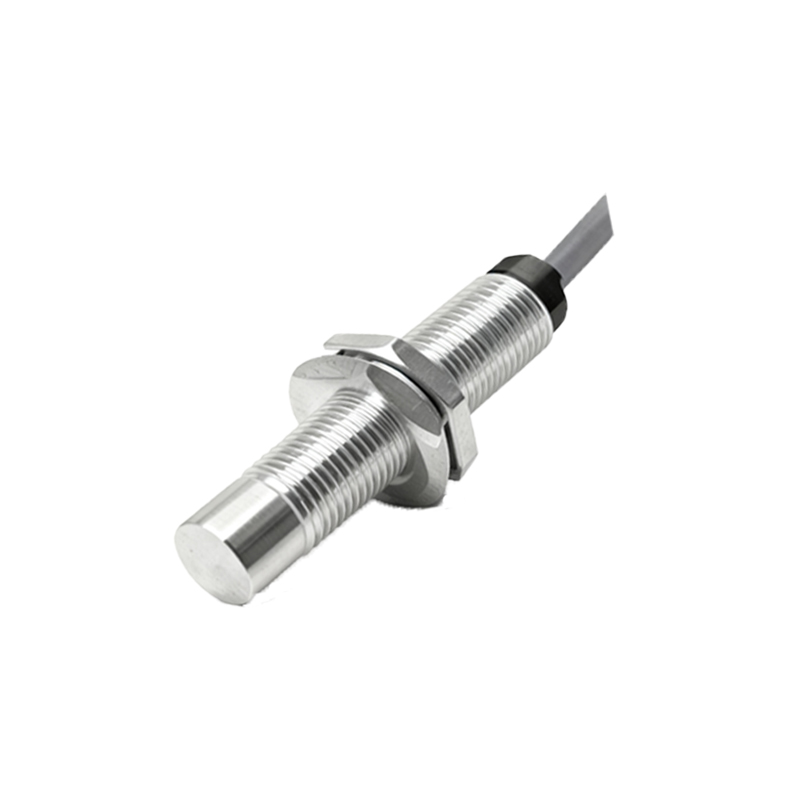
Proximity sensors are fundamental components in modern industrial automation, enabling machines to detect the presence or absence of objects without any physical contact. Their operation hinges on the principle of generating an electromagnetic field or beam and detecting changes within it. The specific sensing mechanism varies significantly depending on the sensor's core technology. The most common types are inductive, capacitive, ultrasonic, and photoelectric sensors, each with distinct operating principles and ideal applications.
Inductive proximity sensors are the workhorses of metal detection in factories. They contain an oscillator circuit that generates a high-frequency alternating electromagnetic field at their active face. When a metallic object enters this field, eddy currents are induced on the object's surface. These currents draw energy from the oscillator, causing its amplitude to decrease. An evaluation circuit monitors this amplitude change. Once the drop reaches a predetermined threshold, the sensor's output state switches, signaling the detection of the target. The sensing distance depends on the metal's properties; ferrous metals like iron and steel are detected at greater distances than non-ferrous metals like aluminum or copper due to higher magnetic permeability. These sensors are renowned for their robustness, high switching frequency, and immunity to environmental factors like dust, oil, or moisture, making them perfect for harsh industrial environments involving machine tools, material handling, and robotic arms.
Capacitive proximity sensors, in contrast, can detect both metallic and non-metallic materials, including liquids, plastics, wood, and granules. They function by generating an electrostatic field. The sensor acts as one plate of a capacitor, with the target object acting as the other plate. As an object approaches the sensor's face, it alters the dielectric constant of the space between them, changing the capacitance of the oscillator circuit. This change in capacitance is evaluated, and when it exceeds a set level, the output switches. Their ability to sense through non-metallic containers makes them invaluable for level detection of liquids, powders, or pellets inside tanks or hoppers. However, they can be more susceptible to environmental influences like humidity or contaminant buildup on the sensing face.
Ultrasonic sensors operate on a time-of-flight principle, similar to sonar. They emit high-frequency sound waves (typically beyond human hearing) in pulses. A transducer acts as both a transmitter and a receiver. The sensor measures the time interval between emitting a sound pulse and receiving its echo after it reflects off a target object. By knowing the speed of sound in the medium (usually air), the sensor can accurately calculate the distance to the object. This allows them not only for simple presence detection but also for precise distance measurement and continuous level monitoring. They are effective for detecting objects of virtually any material, shape, or color, and are less affected by dust, light, or smoke compared to optical methods. Common applications include pallet detection, loop control, and liquid level sensing in challenging conditions.
Photoelectric sensors use light to detect objects. They consist of a light emitter (usually an LED producing visible red, infrared, or laser light) and a receiver. They come in three main operational modes. Through-beam sensors have separate emitter and receiver units; detection occurs when the target object interrupts the light beam. Retro-reflective sensors use a single unit and a reflector; the object is detected by breaking the beam reflected back to the receiver. Diffuse (proximity) sensors have the emitter and receiver in one housing and detect light reflected directly off the target object. The receiver evaluates the intensity of the received light. An object is detected when it causes a sufficient change in this intensity—either by blocking the beam or by reflecting it. Photoelectric sensors offer very long sensing ranges and can detect tiny objects, but their performance can be influenced by the target's color, reflectivity, and environmental factors like ambient light or dirty lenses.
The process of "sensing" is thus a continuous cycle: the generation of a field or beam, the interaction of a target with that field, the detection of a change in the field's properties (amplitude, capacitance, time delay, light intensity), and finally, the conversion of that change into a clean, usable electrical output signal. This output, typically a solid-state switch (PNP/NPN), relays the information to a controller like a PLC, which then triggers the desired action in the automated system. Understanding these core inductive principles is crucial for selecting the right sensor for an application, ensuring reliable operation, and maximizing efficiency in automated processes.