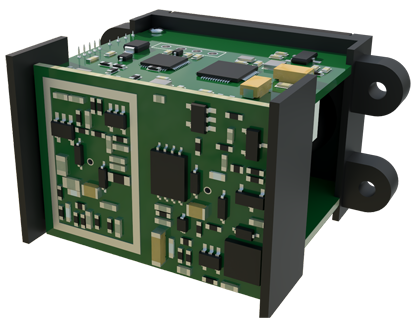
Diffuse reflection laser sensors represent a pivotal technology in modern industrial automation, offering non-contact detection capabilities for a wide range of materials and surfaces. Unlike through-beam or retro-reflective sensors that require separate emitters and receivers, diffuse sensors house both components in a single unit. The operational principle is straightforward: the integrated laser emitter projects a focused beam onto a target surface. A portion of the light is scattered back via diffuse reflection, and the internal receiver detects this reflected signal. The sensor's electronics then process this signal to determine the presence or absence of the target, often providing a digital output to a control system.
The key advantage of this design is its simplified installation. Since only one device needs to be mounted and wired, it reduces mechanical complexity and cost. This makes diffuse laser sensors ideal for applications with space constraints or where mounting a receiver opposite the emitter is impractical. However, this convenience comes with specific operational considerations. The effectiveness of a diffuse sensor is highly dependent on the target's optical properties—its color, surface texture, and material composition.

A bright, matte-white surface provides excellent diffuse reflection, resulting in a strong return signal and a long sensing range. Conversely, dark, glossy, or transparent materials pose significant challenges. Dark surfaces absorb more light, reducing the intensity of the reflected beam. Glossy surfaces can cause specular reflection, where the light reflects at a mirror-like angle away from the receiver. Transparent materials, like glass or clear plastic, may allow most of the laser beam to pass through with minimal reflection. For these difficult surfaces, sensors with background suppression or foreground suppression technologies are employed. These advanced models can differentiate between the target's reflection and the reflection from a more distant background or a very close foreground, enabling reliable detection of low-reflectivity or problematic objects.
Typical industrial applications are vast. In packaging lines, they detect the presence of boxes, bottles, or labels regardless of color variations. In robotic pick-and-place systems, they verify that a component is correctly positioned in a gripper. They are used for counting objects on conveyors, monitoring fill levels in containers, and ensuring proper assembly by checking for the presence of small parts like screws or springs. Their high precision, with sensing distances ranging from a few millimeters to several meters depending on the model and target, allows for versatile integration.
When selecting a diffuse reflection laser sensor, engineers must carefully evaluate several parameters. The stated sensing range is typically defined for a standard white reference target (often 90% reflectivity). For any other material, the effective range will be shorter and must be derated using correction factors provided in the datasheet. Response time is critical for high-speed production lines; modern sensors offer response frequencies in the kilohertz range. The size of the laser spot is another crucial factor; a smaller spot allows for the detection of very small objects or precise edge detection. Environmental robustness is also paramount. Industrial sensors are housed in rugged casings with high Ingress Protection (IP) ratings (e.g., IP67) to withstand dust, moisture, and mechanical vibration. They must also be resistant to ambient light interference from factory lighting or other optical sources.
Maintenance and setup involve correct alignment and sensitivity adjustment, often via a teach-in function or potentiometer. Regular cleaning of the lens is necessary to prevent dust accumulation from attenuating the laser beam. As Industry 4.0 advances, these sensors are increasingly equipped with smart features like IO-Link communication. This allows for remote configuration, real-time monitoring of signal strength, and predictive maintenance alerts, integrating seamlessly into digitalized factory networks.
In conclusion, diffuse reflection laser sensors are indispensable tools for reliable object detection. Their single-unit design offers installation simplicity, while ongoing technological advancements in background suppression and connectivity continue to expand their capabilities. A thorough understanding of their operating principles, limitations related to target surface properties, and key selection criteria is essential for engineers to deploy them effectively, ensuring robust and efficient automation solutions across diverse industrial environments.