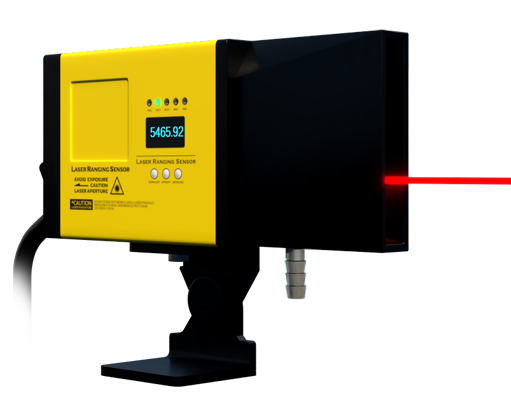
In the rapidly evolving landscape of industrial automation and precision measurement, planar laser sensors have emerged as a cornerstone technology. Unlike traditional point or line lasers, these sensors project a two-dimensional plane of laser light onto a target surface, enabling comprehensive and high-speed profile measurement. This article delves into the operational principles, key advantages, diverse applications, and future trajectories of this transformative technology.
At its core, a planar laser sensor operates on the principle of optical triangulation. The sensor's laser diode emits a fan-shaped beam, creating a bright laser plane. When this plane intersects with an object, the contour of the object deforms the straight line of light. A high-resolution CMOS or CCD camera, positioned at a known angle to the laser emitter, captures this deformed line. Sophisticated onboard processors then analyze the displacement of each point along the line. By applying trigonometric calculations, the sensor generates a precise, real-time 2D profile of the object's cross-section. This profile consists of thousands of individual height (Z-axis) measurements corresponding to specific lateral (X-axis) positions, providing a dense point cloud for a single slice of the object.
The advantages of planar laser sensors over conventional measurement methods are substantial. First and foremost is speed. By capturing an entire cross-sectional profile in a single snapshot, these sensors can perform inspections at rates exceeding tens of thousands of profiles per second, making them ideal for high-speed production lines. Secondly, they offer non-contact measurement, eliminating the risk of damaging delicate surfaces and avoiding wear on the sensor itself. Their high resolution and accuracy, often in the micron range, ensure reliable detection of minute defects, gaps, or dimensional variances. Furthermore, their robustness allows them to perform consistently in challenging industrial environments with vibration, ambient light variations, and dust.
The applications of planar laser sensors span a multitude of industries, driving quality control and process optimization. In automotive manufacturing, they are indispensable for inspecting weld seam quality, measuring panel gaps and flushness, and verifying the dimensional accuracy of critical components like brake discs and engine blocks. In electronics, they ensure the coplanarity of semiconductor leads, measure solder paste volume on PCBs, and inspect the thickness of coatings and displays. The packaging industry relies on them for fill-level detection, container seal integrity checks, and label positioning verification. In logistics, they facilitate parcel dimensioning and volume calculation for warehouse automation. Beyond inspection, they are pivotal in robotics for precise bin-picking guidance and in additive manufacturing for in-process monitoring of layer height and geometry.
Looking ahead, the future of planar laser sensor technology is geared towards greater integration, intelligence, and capability. The convergence with artificial intelligence and machine learning is a significant trend. AI algorithms can be trained on vast datasets of profile images to not only detect anomalies but also classify defect types, predict process deviations, and enable adaptive control systems. The miniaturization of components will lead to more compact sensor designs, allowing installation in space-constrained applications. Enhanced data fusion, where planar laser data is combined with information from other sensor types like RGB cameras or thermal imagers, will provide richer, multi-dimensional insights for complex inspection tasks. Additionally, the development of blue and violet laser models improves performance on shiny, reflective, or transparent materials that traditionally posed measurement challenges.
In conclusion, planar laser sensors represent a paradigm shift in non-contact metrology. By providing fast, accurate, and reliable 2D profile data, they have become an essential tool for ensuring quality, enhancing efficiency, and enabling advanced automation across global industries. As technology continues to advance, their role will only expand, becoming smarter, more integrated, and fundamental to the realization of Industry 4.0 and beyond, where data-driven precision is paramount.