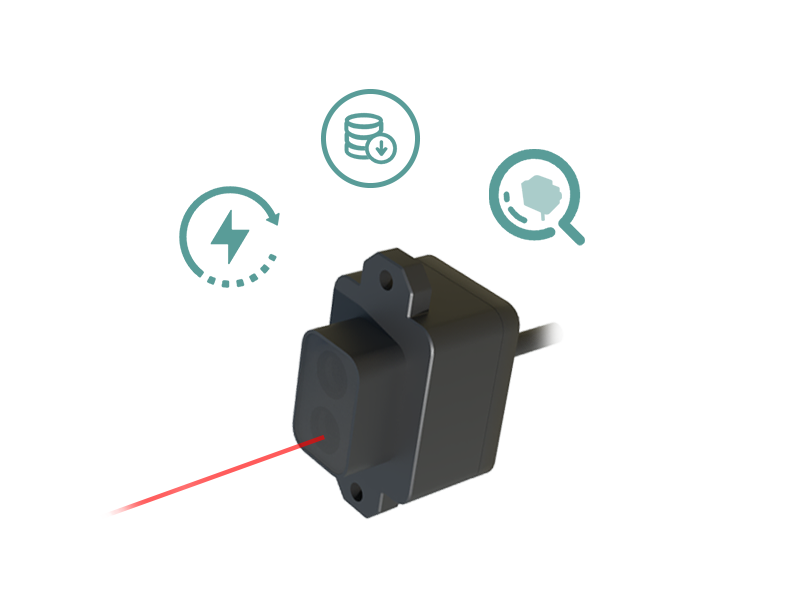
In today's fast-paced industrial landscape, the demand for high-precision, reliable, and efficient sensing solutions has never been greater. Laser sensors, with their unparalleled accuracy and versatility, have emerged as critical components across numerous sectors, including manufacturing, logistics, automotive, and aerospace. As a sales professional in the electrical and automation industry, understanding the technical nuances and market applications of these devices is paramount to driving successful client engagements and closing deals. This guide delves into the core aspects of selling laser sensors, offering insights into their technology, key benefits, target industries, and effective sales strategies.
Laser sensors operate on the principle of emitting a focused beam of light and measuring the reflection to determine distance, position, presence, or dimensions of an object. Unlike traditional mechanical or ultrasonic sensors, they provide non-contact measurement with micron-level precision, even in challenging environments with dust, vibration, or extreme temperatures. Common types include time-of-flight (ToF) sensors for long-range detection, triangulation sensors for high-accuracy short-range measurements, and confocal sensors for detailed surface profiling. When presenting to clients, emphasize how these technologies reduce downtime, minimize wear and tear, and enhance quality control processes. For instance, in automotive assembly lines, laser sensors ensure precise part alignment, while in packaging, they verify fill levels without physical contact, boosting throughput and reducing waste.
The competitive advantage of laser sensors lies in their adaptability. They can be integrated into existing PLC (Programmable Logic Controller) systems, IoT (Internet of Things) networks, and Industry 4.0 frameworks, enabling real-time data analytics and predictive maintenance. Sales pitches should highlight ROI (Return on Investment) by showcasing case studies: a food processing plant that cut inspection errors by 30% after deploying laser-based quality checks, or a warehouse that improved inventory accuracy by 25% using laser scanners for automated tracking. Always tailor discussions to industry-specific pain points—manufacturers may prioritize speed and reliability, while logistics firms focus on durability and ease of integration.
Effective selling requires a deep technical grasp coupled with strong relationship-building. Start by conducting thorough needs assessments to identify client challenges, such as measurement inaccuracies or high maintenance costs. Demonstrate products through live demos or simulation software, stressing features like adjustable sensing ranges, robust housings (IP67 ratings for dust/water resistance), and user-friendly interfaces. Provide comprehensive support, including installation guidance, calibration services, and training programs. Networking at trade shows like Hannover Messe or Automate, and leveraging digital platforms with SEO-optimized content, can expand reach. Remember, trust is built by positioning yourself as a solutions expert, not just a vendor.

Ultimately, the future of laser sensor sales is intertwined with automation trends like collaborative robotics and smart factories. Stay updated on advancements such as AI-enhanced sensor fusion or miniaturized designs for compact spaces. By articulating how laser sensors drive efficiency, safety, and innovation, sales professionals can capitalize on this growing market, fostering long-term partnerships and achieving sustained revenue growth. Focus on delivering value—where every sensor sold translates into tangible operational gains for the client.