In the realm of industrial automation and precision measurement, monochrome laser sensors stand as a cornerstone technology. Unlike their color or RGB counterparts, these sensors operate using a single-wavelength laser source, typically in the visible red spectrum or near-infrared range. Their fundamental principle revolves around emitting a focused beam of coherent light and analyzing the reflected signal to determine distance, presence, thickness, or profile of a target object. The "monochrome" aspect is crucial; it signifies a dedicated, high-purity light source that eliminates chromatic aberration and simplifies signal processing, leading to exceptional accuracy and reliability in demanding environments.
The core advantages of monochrome laser sensors are manifold. First and foremost is their high precision and resolution. By utilizing a single, well-defined wavelength, these sensors achieve sub-micron level measurement stability. The coherent nature of laser light allows for precise triangulation or time-of-flight calculations, making them ideal for applications like wafer alignment in semiconductor fabrication, thickness gauging in rolling mills, or vibration analysis in machinery. Secondly, they exhibit remarkable robustness against ambient light interference. Many models incorporate narrow-band optical filters that only pass the specific wavelength of their own laser, effectively rejecting stray light from factory lighting or sunlight. This ensures consistent performance even in brightly lit or fluctuating light conditions.
Furthermore, monochrome laser sensors offer superior speed and response times. The simplicity of processing a single-wavelength return signal enables very high sampling rates, often in the kilohertz range. This makes them perfect for high-speed production lines, such as detecting minute defects on moving webs, sorting small components on conveyors, or monitoring fill levels in bottling plants. Their response is virtually instantaneous, allowing for real-time control and feedback in closed-loop systems.
Durability and low maintenance are other key benefits. With fewer optical components compared to multi-wavelength systems and no color filters to degrade, monochrome laser sensors are designed for long-term, continuous operation. They are often housed in rugged, IP67-rated enclosures to withstand dust, moisture, oil mist, and mechanical vibrations common in industrial settings like automotive assembly, metalworking, and packaging.
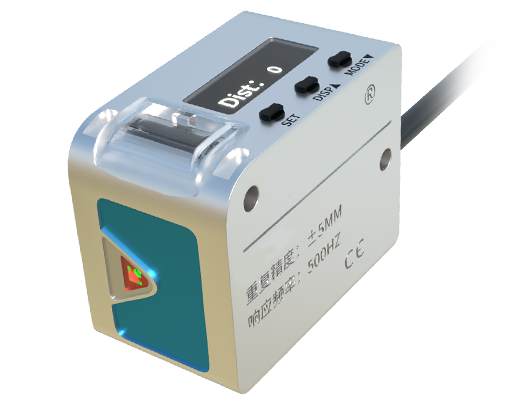
Typical applications span a wide spectrum of industries. In automotive manufacturing, they are used for precise gap and flush measurement between body panels. In electronics, they verify component placement on PCBs. In logistics, they assist in dimensioning packages for warehouse automation. In pharmaceutical production, they monitor tablet coating uniformity. The common thread is the need for a non-contact, high-accuracy, and reliable measurement solution that is indifferent to the target's color or surface pattern. A red object and a blue object, if at the same distance, will yield an identical reading—a significant advantage over color-dependent sensors.
When selecting a monochrome laser sensor, engineers must consider several parameters: measurement range, spot size, linearity, repeatability, and the required interface (analog output, digital I/O, or fieldbus protocols like PROFINET or EtherNet/IP). Environmental factors such as temperature range and the presence of aggressive chemicals also influence the choice of housing and window material.

In conclusion, monochrome laser sensors are a mature, yet continually evolving technology that provides an indispensable solution for precise metrology and object detection. Their simplicity, speed, accuracy, and resilience make them a preferred choice in countless industrial automation scenarios where performance cannot be compromised. As Industry 4.0 advances, integrating these sensors with smart data analytics and IoT platforms will further unlock their potential for predictive maintenance and enhanced process optimization.