In industrial automation and process control, accurate and reliable level detection is paramount for ensuring operational safety, efficiency, and product quality. Among the various technologies employed, water level proximity switch sensors stand out for their robustness, simplicity, and versatility. This article delves into the fundamental operating principles of these critical devices, exploring the common technologies that enable non-contact or limited-contact detection of liquid levels.
At its core, a proximity switch sensor designed for water level detection is a device that changes its output state when the target liquid (typically water or aqueous solutions) reaches or moves away from a predefined sensing point. Unlike continuous level transmitters, these are discrete devices, providing a simple on/off signal. The primary function is to indicate whether the liquid level is above or below the setpoint, triggering alarms, activating pumps, or controlling valves.
Several physical principles are harnessed in the design of these sensors, each with its own advantages and ideal applications.
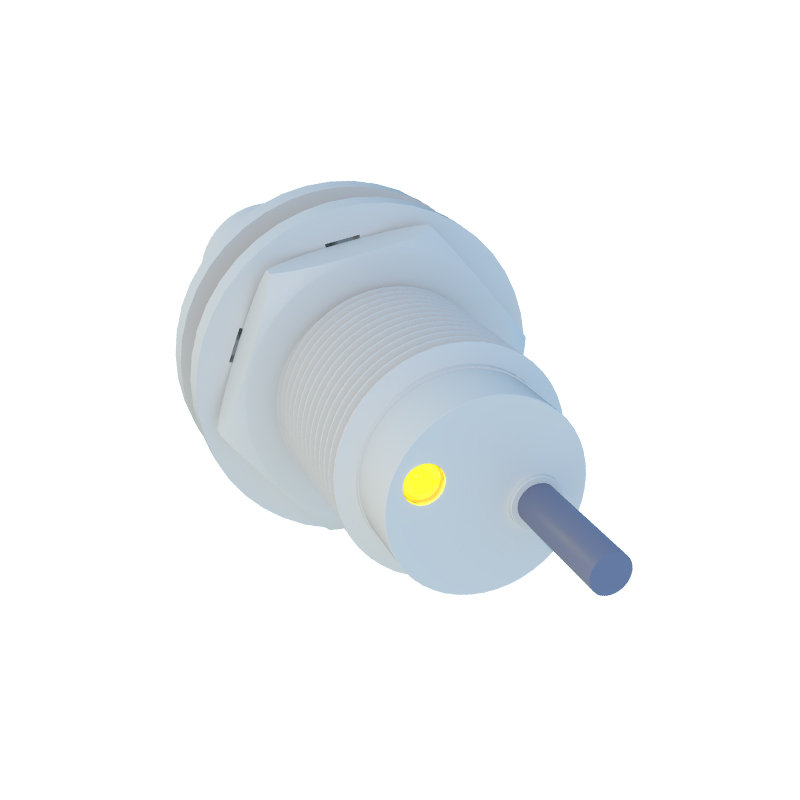
1. Capacitive Proximity Sensors:
This is one of the most common types for liquid detection. The sensor forms one plate of a capacitor, the tank wall (or a reference electrode) forms the other, and the dielectric material between them completes the circuit. Air and water have significantly different dielectric constants (approximately 1 for air and around 80 for pure water). As the water level rises and covers the active face of the sensor, the dielectric constant of the medium changes dramatically. This change alters the capacitance of the system. The integrated oscillator circuit within the sensor detects this capacitance shift. When the change exceeds a predefined threshold, the sensor's output switch (typically a solid-state relay or transistor) changes state. These sensors are excellent for non-metallic tanks and can often sense through thin tank walls, allowing for completely non-intrusive installation.
2. Inductive Proximity Sensors:
While primarily used for detecting metals, inductive sensors can be adapted for water level detection when used with a float containing a permanent magnet or a ferrous metal trigger. The sensor itself is mounted externally on a non-metallic tank. A float, containing a magnet, moves up and down with the liquid level inside the tank. When the float (and its magnet) approaches the sensor position on the outside of the tank, the magnetic field actuates a reed switch or Hall-effect sensor inside the proximity switch, changing its output state. This method provides a hermetic seal as the sensor never contacts the liquid directly.
3. Optical Proximity Sensors:
These sensors utilize infrared or visible light. A common design is the through-beam type, where an emitter and a receiver are positioned opposite each other across the tank. The liquid level interrupts the light beam, causing an output change. Another popular variant is the reflective type, where the emitter and receiver are housed in the same unit. The sensor emits light towards the liquid surface. The difference in reflectivity between air (low reflectivity) and the liquid surface (higher reflectivity) is detected. When the liquid reaches the sensing point, enough light is reflected back to the receiver to trigger the switch. Optical sensors are highly precise but can be susceptible to fouling, bubbles, or changes in liquid color or turbidity.
4. Ultrasonic Proximity Sensors:
These sensors operate by emitting high-frequency sound waves (ultrasonic pulses) towards the liquid surface. They measure the time-of-flight for the sound wave to travel to the surface and reflect back to the sensor. While often used for continuous measurement, they can be configured as a proximity switch by setting a very specific switching distance. When the liquid level reaches this precise distance, the detected echo time matches the setpoint, triggering the switch output. They are true non-contact sensors, ideal for aggressive or sterile liquids, but performance can be affected by vapor, foam, or heavy turbulence.
5. Conductivity (or Resistive) Proximity Sensors:
This is a straightforward and cost-effective principle, suitable for conductive liquids like water. The sensor typically consists of one or more electrodes (probes) inserted into the tank. When the conductive liquid rises and makes contact with the electrode tip, it completes an electrical circuit between the electrode and a reference (often the tank wall or a second electrode). This change in conductivity is detected by the control unit, which switches the output. While simple, this is a contact method and the electrodes may be subject to corrosion, coating, or electrolysis.
Key Considerations for Application:
Selecting the right water level proximity switch involves careful analysis. The chemical composition, temperature, and pressure of the liquid are critical. For capacitive and inductive types, the tank material is a major factor. Installation constraints, required sensing distance, and the need for hygiene (e.g., in food & beverage or pharmaceuticals) also guide the choice. Environmental factors like humidity, dust, and potential for mechanical