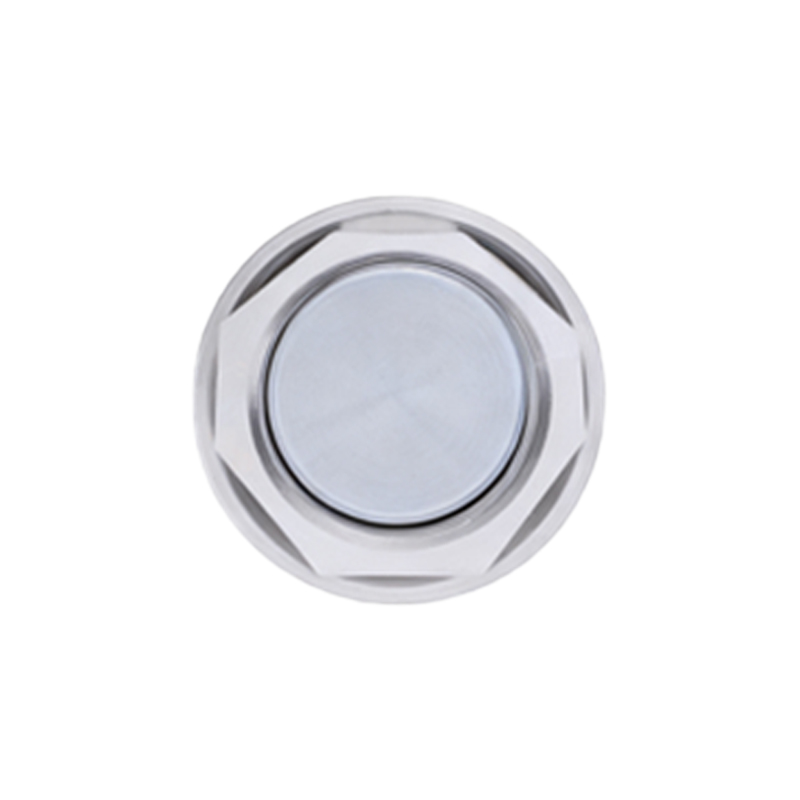
Metal square proximity sensors are essential components in modern industrial automation, offering reliable non-contact detection of metallic objects. These sensors operate on the principle of electromagnetic induction, where an oscillator generates a high-frequency magnetic field from a coil within the sensor's square-shaped housing. When a ferrous or non-ferrous metal target enters this field, eddy currents are induced, causing a change in oscillation amplitude or frequency. This change is detected by the sensor's circuitry, triggering an output signal—typically in the form of a solid-state switch (PNP/NPN) or relay contact—to indicate the presence of the object. The square design provides a robust, compact form factor that is easy to mount in tight spaces, often featuring IP67 or higher ingress protection ratings for durability in harsh environments like manufacturing floors, automotive assembly lines, and material handling systems.
Key advantages of metal square proximity sensors include high switching frequencies, enabling fast response times for high-speed applications such as conveyor belt monitoring or robotic arm positioning. They are immune to environmental factors like dust, oil, and moisture, unlike optical sensors, and require no physical contact, minimizing wear and tear. Common types include inductive sensors for ferrous metals and capacitive variants for broader material detection, though this article focuses on inductive models. Selection criteria involve considering sensing distance (rated operating distance, typically 2-15mm for square models), target material (steel, aluminum, etc.), output configuration, and supply voltage (commonly 10-30V DC). Installation requires attention to mounting orientation, as lateral or flush mounting can affect sensing range, and avoiding interference from adjacent metal structures or other sensors.
In practice, these sensors are deployed for tasks like part counting, limit switching, and safety interlocks. For instance, in packaging machinery, they detect metal lids on containers to ensure proper sealing, while in automotive welding lines, they verify component positioning before robotic welding. Maintenance is minimal, but periodic checks for physical damage, contamination, or output drift are recommended. Innovations in this field include IO-Link compatibility for digital communication, allowing real-time diagnostics and parameter adjustments, and enhanced temperature stability for extreme conditions. Overall, metal square proximity sensors provide a cost-effective, durable solution for precise metal detection, contributing to improved efficiency and safety in industrial operations. As automation evolves, their integration with smart factory systems will continue to expand, supporting Industry 4.0 initiatives.