Proximity sensors are ubiquitous in modern industrial automation, consumer electronics, and safety systems. Their core function is to detect the presence or absence of an object within a specified range without any physical contact. This non-contact operation is their defining characteristic, leading to high reliability, long operational life, and the ability to function in harsh environments. Understanding the working principle of these sensors is fundamental to selecting the right type for a given application.
The fundamental principle behind most proximity sensors involves generating an electromagnetic field or a beam of radiation and then monitoring for changes in that field or beam. The detection occurs when a target object enters the sensor's operational field, causing a detectable change in the signal. This change is then converted by the sensor's internal circuitry into an electrical output signal, typically a simple ON/OFF switch. The absence of moving parts and mechanical wear is a direct result of this non-contact detection method.
Several primary technologies underpin proximity sensors, each with its own distinct operating principle and ideal use cases.
Inductive Proximity Sensors are one of the most common types. They generate an oscillating electromagnetic field from a coil wound around a ferrite core at their sensing face. When a metallic object (the target) enters this alternating field, eddy currents are induced on the surface of the metal. These eddy currents draw energy from the sensor's oscillator, causing a reduction in the amplitude of oscillation. This reduction is detected by the sensor's threshold circuit, which triggers a change in the output state. Inductive sensors are excellent for detecting ferrous and non-ferrous metals but are ineffective for non-metallic materials.
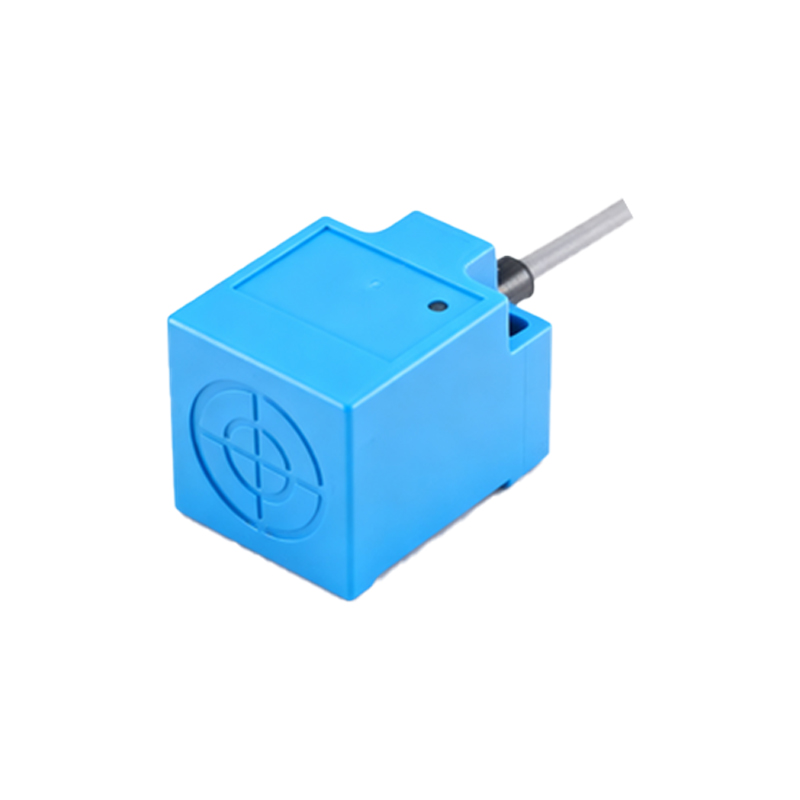
Capacitive Proximity Sensors operate on a different principle. They function like an open capacitor. The sensor's active surface acts as one plate of a capacitor, and the sensed object acts as the other plate, with the air gap as the dielectric. The sensor generates an electrostatic field. When any object with a dielectric constant different from air (which includes almost all materials—metals, plastics, wood, liquids, granules) enters this field, it changes the capacitance of the system. This change in capacitance alters the oscillation amplitude of an internal RC oscillator. Once this change reaches a predetermined threshold, the output state switches. This makes capacitive sensors versatile for detecting a wide variety of materials.
Photoelectric Sensors, another major category, use light to detect objects. They consist of a light emitter (usually an LED producing visible red, infrared, or laser light) and a receiver. They operate in three main modes. Through-beam sensors have separate emitter and receiver units; an object is detected when it interrupts the light beam. Retro-reflective sensors use a single unit with both emitter and receiver, bouncing light off a reflector; detection occurs when the beam is broken. Diffuse (proximity) mode sensors also house both components, but they detect the light reflected directly off the target object itself. The receiver detects the presence or intensity of the reflected light to trigger an output.
Ultrasonic Proximity Sensors use sound waves beyond the range of human hearing. They emit high-frequency ultrasonic pulses and then listen for the echo. By measuring the time interval between the emitted pulse and the received echo (time-of-flight), the sensor can calculate the distance to the target object. This principle allows them to detect objects of virtually any material, as long as the material reflects sound waves. They are particularly useful for detecting transparent objects, liquid levels, or objects in dusty environments where photoelectric sensors might fail.
The choice of sensor technology depends heavily on the application requirements: the material of the target object (metal, plastic, liquid), the required sensing distance, environmental conditions (dust, moisture, temperature), required response speed, and output type (digital ON/OFF, analog, or IO-Link for smart sensors).
Applications are vast. In automotive assembly lines, inductive sensors count metal parts or verify piston position. In food packaging, capacitive sensors detect liquid levels in bottles through glass or plastic. Photoelectric sensors are the backbone of object counting on conveyor belts and safety light curtains. Ultrasonic sensors manage bulk material level in silos and assist in parking assist systems. In consumer electronics, capacitive sensors enable touchless faucets and the screen-off function during phone calls.
In summary, the principle of proximity sensing revolves around the non-contact interaction between a generated field (electromagnetic, electrostatic, light, or sound) and a target object. The resulting perturbation is precisely measured and converted into a usable control signal. This elegant principle enables the precise, reliable, and robust automation that defines modern manufacturing and enhances countless everyday devices.