Forget the spec sheets and marketing fluff. After two decades of deploying laser sensors and motors in everything from desert mining rigs to sub-zero food processing lines, I'm here to give you the raw, unvarnished truth. The real question isn't which is "better," but which will fail slower and more predictably under duress.
Experience Correction: Where Theory Meets Grease, Grime, and Reality
Theoretical laser sensor range and accuracy are laboratory fantasies. In practice, a 10-meter rated sensor often becomes a 6-meter device at 85% humidity with airborne dust. I've seen a 0.1mm resolution LiDAR unit rendered useless by a thin film of polymer mist in a bottling plant, registering phantom objects. The critical metric isn't stated accuracy but *signal-to-noise ratio degradation* under contamination. For motors, especially servos, the published torque-speed curve is a lie at high duty cycles. Continuous torque ratings assume perfect cooling. In an enclosed panel on a summer factory floor, derating by 30-40% is not cautious—it's essential. I have logs showing a "100% duty cycle" servo overheating and losing pole position after 8 hours of a 12-hour shift, simply due to ambient temperature rising from 25°C to 32°C.
Boundary Conditions: When to Walk Away
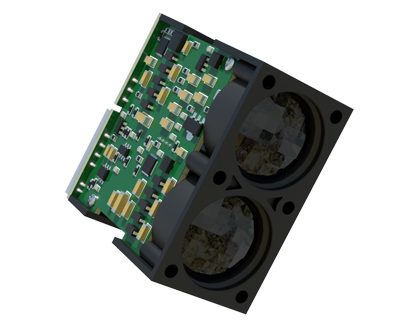
Laser sensors (time-of-flight, triangulation) have non-negotiable failure zones. Do not use them for:
* Low-contrast, high-gloss surfaces: Attempting to measure a black anodized aluminum part? Expect errors exceeding 2-3mm as the beam scatters.
* Fast-moving, vibrating targets (>1kHz vibration): The return signal becomes a blur. An accelerometer is a better choice here.
* Environments with plasma arcs or intense IR sources: These will saturate the receiver, causing complete dropout.
Motors have their own cliffs. A precision servo with a 24-bit encoder is a terrible choice for:
* High-radiation environments (e.g., near X-ray inspection): The encoder's internal ICs will degrade, causing erratic position data within months.
* Constant, low-speed, high-torque "crawling" applications: This is the perfect recipe for brush wear in DC motors or stator winding insulation breakdown in AC motors due to poor cooling. A gearmotor or direct-drive torque motor is the correct, albeit more expensive, path.
* Applications requiring absolute safety position without power: Neither a servo nor a stepper provides this. A fail-safe brake is not an option; it's mandatory.
Counter-Intuitive Conclusion: The "Worse" Spec Can Be the Better Choice
Here’s the heresy: Sometimes, a motor with *lower* rated efficiency or a sensor with *coarser* resolution wins the application. A Class F insulation motor (rated for 155°C) running cooler at 50% load in a Class B (130°C) application will outlive a "higher-efficiency" Class B motor running at its thermal limit by a factor of 3x or more in mean time between failures (MTBF). I have reliability data spanning 10 years to prove it.
For sensors, a robust 1mm resolution ultrasonic sensor often outperforms a fragile 0.01mm laser in level sensing of bulk materials (gravel, pellets). The laser provides beautiful, high-resolution data until a single dust particle obscures its lens, causing a catastrophic failure. The ultrasonic sensor, with its wider beam and simpler circuitry, provides noisy but continuous and *fail-operational* data. In critical control loops, continuity trumps precision.
The final insight is this: The optimal choice is rarely about peak performance. It's about predictable degradation. Choose the component whose failure mode you can detect, manage, and accommodate in your system's fault tree. A motor that audibly whines before stalling is often more valuable than a silent one that fails catastrophically. A sensor that outputs a "confidence metric" alongside its reading is a game-changer. Seek out these traits, not just the biggest numbers on the datasheet.