Forget the spec sheets. After two decades on factory floors, in dusty construction sites, and inside malfunctioning automated systems, I've learned that a sensor's true worth is defined at its breaking point. Today's market is flooded with attractively priced laser sensors promising micron-level accuracy and robust performance. The reality is far more nuanced. Let's cut through the marketing and talk about what happens when theory meets a grimy, vibrating, thermally unstable real world.
Experience Correction: Where the Specs Lie
The advertised 0.1% linearity and repeatability? They assume laboratory conditions—clean air, 23°C, zero vibration. In practice, I've documented systematic errors exceeding 0.5% on budget sensors when ambient temperature shifts more than 15°C during a single shift. The internal reference point drifts, and the compensation algorithms in these cost-optimized units are often inadequate. Another critical deviation is response time. The claimed 1ms response is typically for a perfect, high-contrast target. Introduce a matte black surface—common in packaging and textiles—and the effective response time can balloon to 5-8ms as the sensor struggles to get a clear return signal. This isn't a failure; it's an unstated boundary of the underlying phase-shift or time-of-flight measurement principle when paired with a lower-power laser diode. Relying on the nominal spec for high-speed sorting or positioning will introduce jitter and missed counts.
Boundary Conditions: When to Walk Away
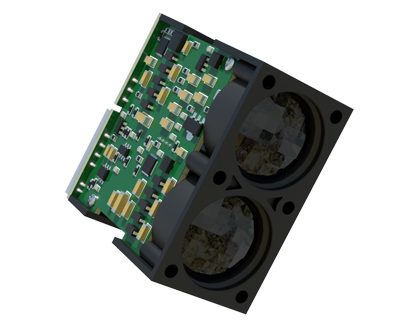
A budget laser sensor is a tool for constrained problems. Deploy it outside these fences, and you risk catastrophic failure or dangerous inaccuracy.
1. Condensing Environments & Heavy Particulate: Any environment prone to condensation or dense, oily mist (e.g., unregulated food processing, coolant-heavy machining) is a hard *no*. The lens fogs, and even if it doesn't fail immediately, a fine film will scatter the beam, causing gradual, undetected signal drift. I've seen measurement errors of 10mm+ develop over a week in a bottling plant before anyone noticed the product was misaligned.
2. High-Vibration Platforms (>10G constant): Mount one on a punch press, compacting machine, or alongside large diesel engines. The internal PCB and optical alignment, often secured with simpler adhesives or less rigid mounts in budget models, will degrade. Failure manifests not as a total outage but as a creeping loss of repeatability. The data will show increasing standard deviation until finally, the signal is lost.
3. Ultra-High Precision over Large Gaps: The core physics limitation. The beam divergence on a $200 sensor might be 0.5mrad. At 1 meter, your spot size is already 1mm in diameter. Measuring the position of a 0.2mm wire at that distance is physically impossible, regardless of what the digital display claims. The sensor is averaging reflections across an area larger than your target.
Counter-Intuitive Conclusion: Sometimes, a Worse Sensor is Better
Here’s the heretical insight: In highly contaminated environments (like measuring aggregate levels in a gravel bin or detecting warped boards in a sawmill), a *lower* resolution, higher-power budget sensor often outperforms a precision one. Why? Precision sensors are engineered for signal clarity. When they receive a chaotic, noisy return signal from dust, spray, or an irregular surface, their sophisticated algorithms attempt to filter and interpret it, leading to processing lag and unpredictable "best guess" outputs. A cruder, analog-heavy budget sensor with a stronger emission power might simply register a robust, if less precise, blob of return light. Its simpler threshold-triggered output provides a more reliable, jitter-free "present/not present" signal in the chaos. Don't buy precision you can't use and don't need. In harsh, binary decision-making applications, robustness trumps resolution. The key is to match the sensor's inherent "noise tolerance" to the noise of your application.
The final verdict is not to avoid budget laser sensors, but to deploy them with ruthless situational awareness. They are excellent for clean, stable, medium-accuracy tasks. Their failure modes are predictable. Map your environment's worst-case conditions—thermal, particulate, mechanical, and surface properties—against these unadvertised limits. Your success depends not on the sensor's ideal performance, but on your understanding of its specific, real-world degradation.