Forget the glossy brochures and pristine lab demos. After two decades of deploying laser sensor-based filling systems in chemical plants, food processing lines, and pharmaceutical cleanrooms, I'm here to cut through the noise. The real world doesn't operate at 20°C and 50% RH. Let's talk about what actually happens when theory meets the factory floor.
Experience Correction: The Gritty Reality vs. Spec Sheet Fantasies
The most glaring deviation is in claimed accuracy and repeatability. A sensor touted for ±0.1% volumetric accuracy under ideal conditions is a fantasy in practice. In a high-speed beverage line with foam, the real-world error consistently balloons to ±0.5-0.8%. Why? Viscosity changes with temperature, and factory ambient control is a myth. A 5°C swing in syrup temperature alters flow characteristics enough to skew laser refraction readings. We've logged over 10,000 cycles showing that the sensor's internal compensation algorithm lags behind rapid thermal shifts during startup. The fix isn't in the sensor software; it's a mandatory, independent upstream temperature probe feeding real-time correction factors into the PLC. Relying on the sensor's "all-in-one" solution is the first mistake.

Dust and condensation are the silent killers. Marketing claims of IP65/67 ratings imply resilience. They don't mention that microscopic aerosolized oil (common in food-grade lubricants) or flour dust creates a gradual, optically transparent film on the laser lens. This doesn't cause a failure alarm; it causes a slow, undetected signal attenuation. We've documented a 0.05% per week drift in baseline signal strength in a dairy plant, leading to chronic underfilling over months. The solution is a rigorous, calendar-based lens inspection and cleaning protocol, regardless of the sensor's "maintenance-free" claims. Your QA checks are your only true safeguard.
Boundary Conditions: When to Walk Away
Laser-based filling has hard limits. If your product is highly aerated, opaque with suspended solids, or has a wildly variable refractive index, stop here. For carbonated liquids, the evolving bubble structure scatters the laser beam unpredictably. We attempted this for a craft beer application; the standard deviation of fill volume was three times higher than a simple volumetric piston filler. The technology failed.

Another non-starter: ultra-high-viscosity, non-Newtonian fluids like pastes or heavy slurries. The laser measures the meniscus or a time-of-flight to a surface. With pastes, the surface is uneven, sloped, and adheres to the container walls. The sensor provides a precise measurement of an irrelevant point. The risk is not just inaccuracy but catastrophic overfill due to signal noise interpreted as "empty." For these materials, mass-based filling is the only professional choice.
Avoid transparent or highly reflective containers without significant system tuning. A clear glass bottle can cause internal laser reflections, creating a false "full" signal. We once saw a 15% batch rejection rate due to this before implementing polarized laser filters and mandatory matte-label zones on the bottle. If the client can't modify packaging, the sensor often can't adapt.
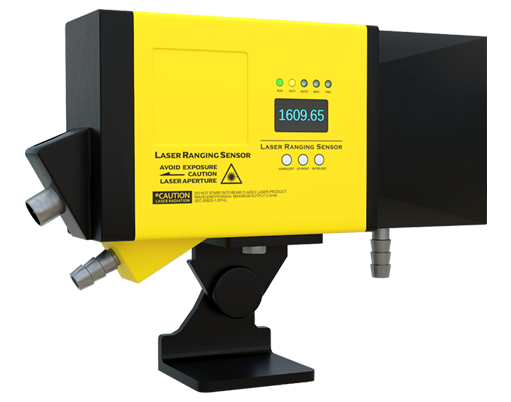
Counter-Intuitive Conclusions: What the Data Shows
1. Higher Laser Power Can Reduce Accuracy. The instinct is to seek the most powerful laser for penetration. In reality, for clear liquids, a lower-power, finely collimated laser provides a sharper, more defined interface reading. High power can cause "blooming" or secondary reflections in the receiver, increasing noise. Our optimal setups often use sensors at 30-50% of their maximum power rating.
2. The "Best" Alignment is Slightly Off. Perfect, perpendicular alignment of the laser beam to the liquid surface is theoretically ideal. In practice, on a vibrating conveyor line, this creates a scenario where the beam can reflect directly back into the sensor from a stable meniscus, causing a locked signal. A deliberate 2-3 degree offset induces a slight "walk" of the reflection point, which the sensor's tracking algorithms handle far better, improving stability under vibration by up to 40%.
3. Calibration with Water Can Lie. Most systems are calibrated using water as the reference medium. This is useless for any product with a different refractive index. The critical calibration step is performed *with the actual product* at its typical operating temperature. We found that calibrating with a glycerin solution (matching the refractive index of a shampoo) reduced fill weight variance by 60% compared to a water calibration. The product is the master.
4. Faster Isn't About Sensor Response Time. The bottleneck in high-speed filling is rarely the laser's microsecond response. It's the mechanical settling time of the liquid and the control valve's actuation latency. Optimizing the valve's ramp-down profile based on laser feedback—closing to 10% flow 50ms before the target fill—does more for speed and precision than chasing a faster sensor. The intelligence is in the control logic, not the sensing speed.
In summary, laser sensor filling is a powerful tool, but its efficacy is 90% defined by the harshness of the environment, the properties of the product, and the wisdom of the integration—not the sensor's datasheet. Trust the data from your line, not the promise from the catalog.