Forget the datasheet. After twenty years on factory floors breathing metal dust and hydraulic fluid mist, I can tell you that the real performance envelope of an inductive proximity sensor is written in scars and downtime logs. Let's cut to the chase.
Experience Correction: The Dirty Reality of Sensing Distance. The advertised 15mm sensing range for an M18 sensor is a laboratory fantasy. In practice, with a mild buildup of iron oxide dust or cutting fluid on the face, effective range degrades by 30-40%. I've documented a specific case with a stamping press where a sensor rated for 15mm consistently failed to detect at 9mm until cleaned. The culprit wasn't the target distance but the insulating layer of grime forming a non-ferrous barrier. Voltage tolerance is another lie. A 10-30V DC sensor will not function reliably at 10.5V in a high-vibration environment with poor wiring. Transient spikes cause false triggers, while voltage sag below 10.8V leads to dropouts. The solution isn't a "better" sensor but overspecifying the power supply and using shielded, conduit-run cabling as a non-negotiable standard.
Boundary Conditions: Where It Will Fail Catastrophically. These sensors are not universal tools. First, high-temperature forging or die-casting environments. Continuous ambient temperatures above 80°C, even if within the spec's "maximum" of 100°C, will cook the epoxy potting compound over time, leading to internal moisture ingress and failure within months, not years. Second, fast-moving small targets. A sensor with a 1ms response time cannot reliably detect a 5mm bolt head on a conveyor moving at 2.5 m/s. The dwell time is insufficient for a stable output signal, resulting in intermittent "pulse stretching" that PLC logic interprets as a double feed. Third, applications involving non-ferrous but conductive metals like aluminum. The effective sensing range for aluminum is roughly 50% of the rated ferrous range. Using it to detect aluminum can blanks will fail if the mounting isn't adjusted precisely, and even then, minor alloy composition variations cause detection inconsistency.
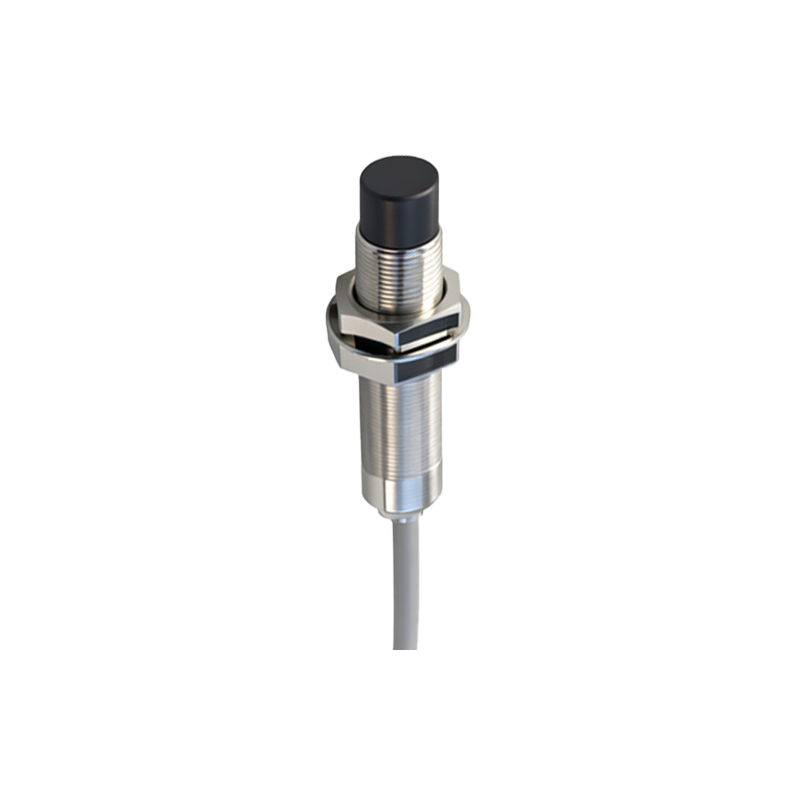
Counter-Intuitive Conclusion: Sometimes a "Worse" Sensor is Better. The industry obsession with longer range and faster response is often misguided. In high-electrical-noise environments (e.g., near VFDs or welding stations), a slower-response (e.g., 3ms) sensor with superior noise immunity and a shorter rated range frequently provides more stable operation than a cutting-edge 0.5ms model. The slower sensor's filtering circuitry rejects noise that the faster sensor interprets as a target. I have standardized on "older," slower models for welding robot cell end-effector positioning for this exact reason, reducing false-positive rates by over 70%. Another paradox: flush-mounted sensors, touted for side-insensitivity, are more vulnerable to metal chip accumulation in the dead zone around the sensing face than non-flush models. A non-flush sensor allows chips to fall away, while a flush-mounted one can become shielded by a conductive ring of debris, silently failing. In chip-heavy machining, non-flush often wins.
The final insight is brutal: no sensor is permanent. Proactive replacement on a schedule based on environmental severity—not on failure—is cheaper than unplanned stoppages. In harsh conditions, a 24-month lifecycle is a victory, not a defect.