Forget the glossy brochures and pristine lab data. After two decades of deploying range laser distance sensors in steel mills, mining pits, and offshore rigs, I've learned that the real performance is written in grime, vibration, and thermal drift. This isn't a primer; it's a debriefing from the field.
Experience Correction: Where Theory Meets Grit
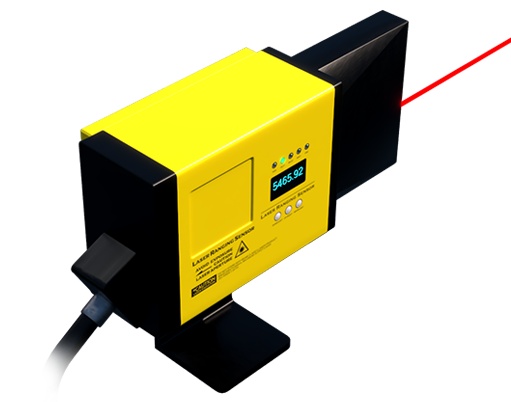
The datasheet promises 0.1% accuracy and a 200-meter range. In practice, these numbers are conditional fantasies. The primary deviation isn't the sensor's fault—it's the medium. Industrial atmospheres are rarely clear. Dust, steam, and oil mist are not just obstructions; they are signal attenuators and false-return generators. A sensor rated for 200m in "ideal conditions" will reliably deliver precision only up to 60-70m in a cement plant's packing area. The advertised accuracy assumes a pristine, high-reflectivity target. Paint a vibrating conveyor belt with dark, matte-finish material, and you can immediately add a 0.5-1% systematic error due to diffuse reflection and low signal-to-noise ratio. The most critical, unlisted parameter is not range or accuracy, but *signal stability* under low-reflectivity and particulate interference. I've seen more systems fail from inconsistent readings than from outright measurement error.
Boundary Conditions: When to Walk Away
This technology has hard limits, and ignoring them is costly. First, transparent media: Measuring through glass, clear plastics, or even heavy rain is a gamble. The laser may measure the first surface, penetrate for a partial return, or create a composite ghost signal. Never use it for level sensing behind a sight glass without extensive, scenario-specific validation. Second, highly volatile environments: In areas with rapidly fluctuating temperatures (e.g., near furnace doors or cryogenic outlets), the thermal settling time of the laser diode and internal optics can cause drift exceeding the stated accuracy for minutes. Third, foam and bubbling surfaces: Trying to measure the level of a frothy liquid or aerated slurry is futile. The beam will scatter on the chaotic surface, returning a noisy, meaningless value that dances across the display. Fourth, safety-critical positioning: Never rely solely on a single laser sensor for final "stop" commands in collision avoidance for cranes or AGVs. Use it as a secondary, overspeed, or pre-warning system. EMI from large variable-frequency drives can induce fatal glitches.
Counterintuitive Conclusion: Sometimes, Slower and Dumber is Better
Here’s the heresy: In high-noise industrial environments, the latest ultra-high-speed, millimeter-precision sensor is often the wrong choice. Its sophisticated signal processing, designed to filter noise, can be overwhelmed by the chaotic, persistent interference of a real plant, leading to "filtering artifacts" and delayed outputs. A robust, mid-range sensor with a longer integration time and a stronger, simpler pulse laser will often provide *more reliable and actionable* data for control systems. It trades peak precision for signal integrity. Furthermore, the obsession with absolute accuracy is misplaced for 90% of industrial applications. What matters more is *repeatability* and *long-term stability*. A sensor that consistently reads 502mm for a 500mm distance (a 0.4% error) is infinitely more valuable than one that alternates between 499mm and 501mm (a 0.2% error) randomly. Control logic can compensate for a known offset; it cannot manage unpredictable noise. The ultimate insight: Your most crucial calibration tool isn't a calibration target—it's a data logger. Plot the sensor's output over 72 hours of plant operation. The graph will reveal the *real* performance envelope far more accurately than any ISO certificate.