For two decades, I've specified, installed, and cursed laser proximity sensors in environments ranging from pristine cleanrooms to foundry floors caked in graphite dust. Forget the datasheet platitudes. Here's what you won't find in the marketing brochures.
Experience Correction: The Reality vs. The Spec Sheet
The stated 0.1% repeatability? Achievable only in a 23°C lab with a pristine, matte-white target. In practice, thermal drift is your silent enemy. A sensor rated for 0-50°C might claim ±0.5% full-scale error over the range. In reality, a sudden 15°C ambient shift near a furnace door can induce a temporary 1.2% deviation as internal components expand at different rates, causing false triggers on tight tolerance (±0.3mm) positioning applications. The fix isn't just a better sensor; it's mandatory thermal shielding or choosing a model with active internal temperature compensation—a feature often buried in the technical notes.
Regarding response time, the 1ms figure is a best-case scenario. Add a standard M12 connector with 5 meters of cable, and capacitive loading can push that to 1.8ms. In high-speed bottling lines running at 60,000 units per hour, that 0.8ms discrepancy is the difference between detection and a massive jam. The lesson: always bench-test the *entire system*—sensor, cable, and controller—under dynamic conditions.
Boundary Conditions: When to Walk Away
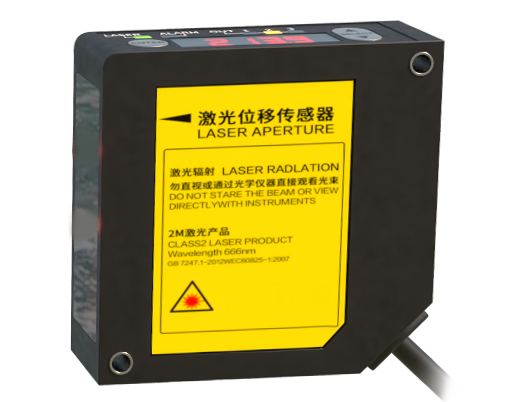
Laser triangulation sensors are not universal tools. Their failure modes are specific and catastrophic.
1. Transparent/Highly Reflective Surfaces: Attempting to detect clear glass or polished stainless steel isn't just unreliable; it's dangerous. The laser beam may penetrate or specularly reflect, causing wildly inconsistent readings or total dropout. I've seen systems fail to detect a missing glass vial, leading to thousands of dollars in downstream damage. For these materials, a confocal chromatic or ultrasonic sensor is mandatory, not an alternative.
2. Condensing Atmospheres & Heavy Particulate: In food processing coolers or pulp mills, airborne moisture or dust doesn't just reduce signal strength—it creates a false background signal. The sensor may lock onto the water vapor or dust plume, reporting a constant "object present" state. Even purged housings fail if the laser window itself becomes coated. In these environments, a mechanical contact probe or a radically different technology (e.g., microwave radar) is often the only robust solution.
3. High-Vibration Environments: Mount a standard laser sensor directly on a punch press or compressor, and you'll witness premature failure of the laser diode's internal bonds. Vibration-resistant models exist but specify *both* the frequency range and the g-force tolerance. A sensor rated for 10g at 55Hz is useless on equipment causing 15g shocks at 100Hz. The resulting intermittent faults are a maintenance nightmare.
Counterintuitive Conclusion: Sometimes a "Worse" Sensor is the Better Choice
The industry pushes higher resolution and faster speeds. However, in harsh, dirty environments, a sensor with a slightly larger laser spot (e.g., 3mm instead of 1mm) and a slower, more robust filtering algorithm often delivers superior uptime. The larger spot averages over small surface contaminants (like oil splatter or rust flakes), reducing noise. The slower response filters out transient interference from welding arcs or passing forklifts. Chasing the highest spec leads to a fragile, "brittle" system. The most reliable installation I oversaw used a decade-old sensor model with a 5ms response time on a descaling line; newer, "faster" models failed weekly due to water and scale interference. Durability and signal integrity often trump peak theoretical performance. Furthermore, the push for miniaturization is a double-edged sword. A compact sensor has less internal space for component isolation, often making it more susceptible to EMI from variable-frequency drives (VFDs) than its larger, older counterpart. In industrial automation, proven robustness frequently resides in slightly older, more "over-engineered" technology.