For two decades, I've watched LiDAR sensors fail in ways datasheets never predict. The industry obsesses over point cloud density, range, and angular resolution. In reality, these are vanity metrics until tested against the chaos of real-world deployment. Let's move past the marketing slides.
Experience Correction: The Gritty Reality vs. Lab Parameters
The advertised 200-meter detection range for a 905nm automotive-grade LiDAR is a theoretical maximum, achieved under pristine lab conditions with 90% reflectivity targets. In practice, on a wet asphalt road at dusk with a dirty sensor window, effective range for a low-reflectivity target (like a black tire fragment) can plummet to under 70 meters. The critical factor isn't peak power but signal-to-noise ratio (SNR) under photon starvation. Lens coatings touted as "hydrophobic" degrade within 6-12 months of exposure to road salt and UV radiation, increasing crosstalk and reducing effective aperture. MEMS-based scanning systems boast reliability, but their microscopic mirrors are susceptible to low-frequency vibration harmonics common in heavy-duty mining vehicles, leading to point cloud distortion that no software can fully rectify. The real metric is Mean Time Between Failure (MTBF) in a vibrational profile matching your application, not a benign office environment.
Boundary Conditions: When LiDAR Becomes a Liability
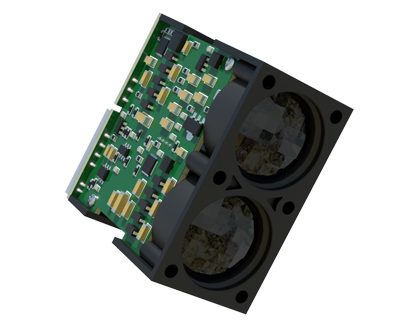
LiDAR is not a universal solution. Understanding its failure modes is crucial for system safety.
1. High-Aerosol Environments: Pulp and paper mills, fog, or heavy snow. Here, LiDAR doesn't just "see less"; it generates persistent phantom objects from backscatter, creating a hazardous noise floor that can trigger emergency stops. Relying on it as the primary sensor here is a design flaw.
2. Extreme Surface Interactions: Specular surfaces (polished metal, calm water) and perfectly absorptive surfaces (black velvet) represent optical cliffs. A LiDAR may report "no object" when pointing at a large, angled stainless steel tanker truck, a catastrophic miss. Conversely, a shallow puddle can be interpreted as a bottomless pit.
3. High-Speed Relative Motion: While LiDAR excels at static scene mapping, for high-speed (>120 km/h) closing rates on complex moving targets (e.g., a motorcycle splitting lanes), the combination of scan latency, low revisit rate per azimuth, and motion distortion can make object vector estimation unreliable. It must be fused with a high-frame-rate radar to close the control loop.
4. EMI-Rich Settings: Near large arc welders or high-voltage transformers. The sensitive analog front-end of LiDAR receivers can be swamped by electromagnetic interference, causing sporadic, undiagnosable dropouts. Shielding is often an afterthought but must be primary.
Counter-Intuitive Conclusions: Data-Driven Heresies
1. Higher Resolution Can Increase System Latency. Doubling the point cloud density doesn't just double data; it can quadruple processing time for clustering and classification algorithms, increasing total perception cycle time. A slightly sparser but more intelligently scanned point cloud (e.g., adaptive scanning) often yields better real-world performance than a maximally dense one.
2. Solid-State is Not Inherently More Reliable. While lacking moving parts, solid-state LiDAR (Flash or OPA) faces its own demons. Flash LiDAR suffers from severe range-intensity coupling: a nearby bright object can saturate the entire sensor array, blinding it to distant critical targets in the same frame. Optical Phase Array (OPA) systems battle with side lobes, creating ghost echoes at fixed angular offsets from real targets.
3. The Most Important Component is the Window, Not the Laser. The optical window is the system's greatest vulnerability. Its material (e.g., germanium for 1550nm) must be chosen not just for transmission, but for minimal thermal lensing. A window heating unevenly from sun load introduces non-linear refractive index changes, bending laser paths and distorting the entire coordinate system. Calibration is invalid until the window reaches thermal equilibrium—which it rarely does in operation.
4. Sensor Fusion Often Masks LiDAR Deficiencies, But Creates New Ones. Fusing LiDAR with camera and radar is mandatory, but the Kalman filter is a liar. It will confidently report a fused object state while obscuring which sensor is failing. A deep, often overlooked, risk is temporal misalignment. A 10-millisecond skew between sensor timestamps at 100 km/h translates to a 0.28-meter positional error, enough to misclassify a curb. Synchronization must be hardware-level, not software-post-processed.
The ultimate takeaway: LiDAR selection is an exercise in managing compromises under stress. Bench-test the sensor under the worst-case environmental insult your application will face—not the average. The spec that matters is performance under degradation.