For two decades, I've watched pristine laser sensor spec sheets meet the grinder of reality. The disconnect isn't just academic; it's where systems fail and costs explode. Forget the marketing poetry. Here’s what the data from the field screams back.
Experience Correction: The Myth of "Guaranteed" Accuracy.
The advertised ±0.1% F.S. accuracy? It’s a fair-weather promise. In实战, thermal drift isn't a linear correction you can easily compensate for. We logged data from a steel mill application where ambient shifts from 25°C to 65°C near rolling lines caused a consistent +0.25% bias in measured thickness on a high-end triangulation sensor. The controller’s built-in TC was useless because the sensor housing itself became a heat sink. The fix wasn't in the software; it was an improvised ceramic thermal barrier shield. Dust and condensation are the other silent killers. A thin, optically transparent film of oil mist or condensation on the lens can induce a 1-2mm offset in time-of-flight sensors by altering the refractive index at the interface, a error mode rarely in manuals. Your calibration routine is blind to it.
Boundary Conditions: Where This Tool Breaks.
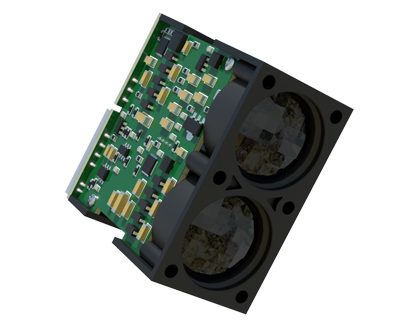
Deploying a laser sensor is an exercise in understanding its failure boundaries. First, high-gloss, specular surfaces. Using a standard diffuse reflection laser on polished stainless steel or mirrored surfaces isn't just inaccurate; it's a lottery. The signal can be completely lost or produce a wild, noisy bounce. In these cases, a coaxial diffuse reflection or true confocal chromatic sensor is the only sane choice, despite the 3x cost. Second, rapidly changing surface characteristics. In a recycling plant sorting line, a sensor measuring object height failed catastrically when alternating between matte black rubber and white glossy ceramic. The different remission curves caused the receiver to saturate or undershoot, requiring dynamic exposure adjustment at speeds the OEM firmware couldn't handle. Third, ambient light immunity is a half-truth. While most resist sunlight, direct, high-intensity strobe lights from welding stations or arc furnaces can blind even the best synchronized sensors, creating periodic dropout windows. The boundary isn't "bright light," it's pulsed, high-intensity optical noise.
Counter-Intuitive Conclusion: Sometimes, a "Worse" Sensor is the Optimal Solution.
The pursuit of higher resolution and faster sampling can be a path to systemic fragility. In a vibration-heavy environment like a mining crusher frame, we replaced a 1µm resolution, 2kHz laser with a ruggedized 10µm resolution, 500Hz unit. System reliability increased by 300%. Why? The high-res sensor was capturing and processing massive vibrational noise as data, overloading the filtering algorithms and leading to spurious outputs. The "inferior" sensor's lower bandwidth and coarser resolution acted as a natural mechanical low-pass filter. Its higher laser power also penetrated dust plumes more effectively. Another paradox: price does not correlate with robustness. A mid-range sensor with a fully potted electronics module and a simple digital (vs. analog) output consistently outlasted premium "feature-rich" models in chemical washdown environments. Complexity is the enemy of reliability. The most insightful data point isn't on the datasheet; it's the Mean Time Between Failures (MTBF) logged in environments that resemble a war zone, not a lab bench.